
NEWS
Claude Asks to Keep Voice Recordings It Once Deleted
Anthropic is asking Claude users to donate voice recordings for training, a speech corpus it cannot scrape from the public web.

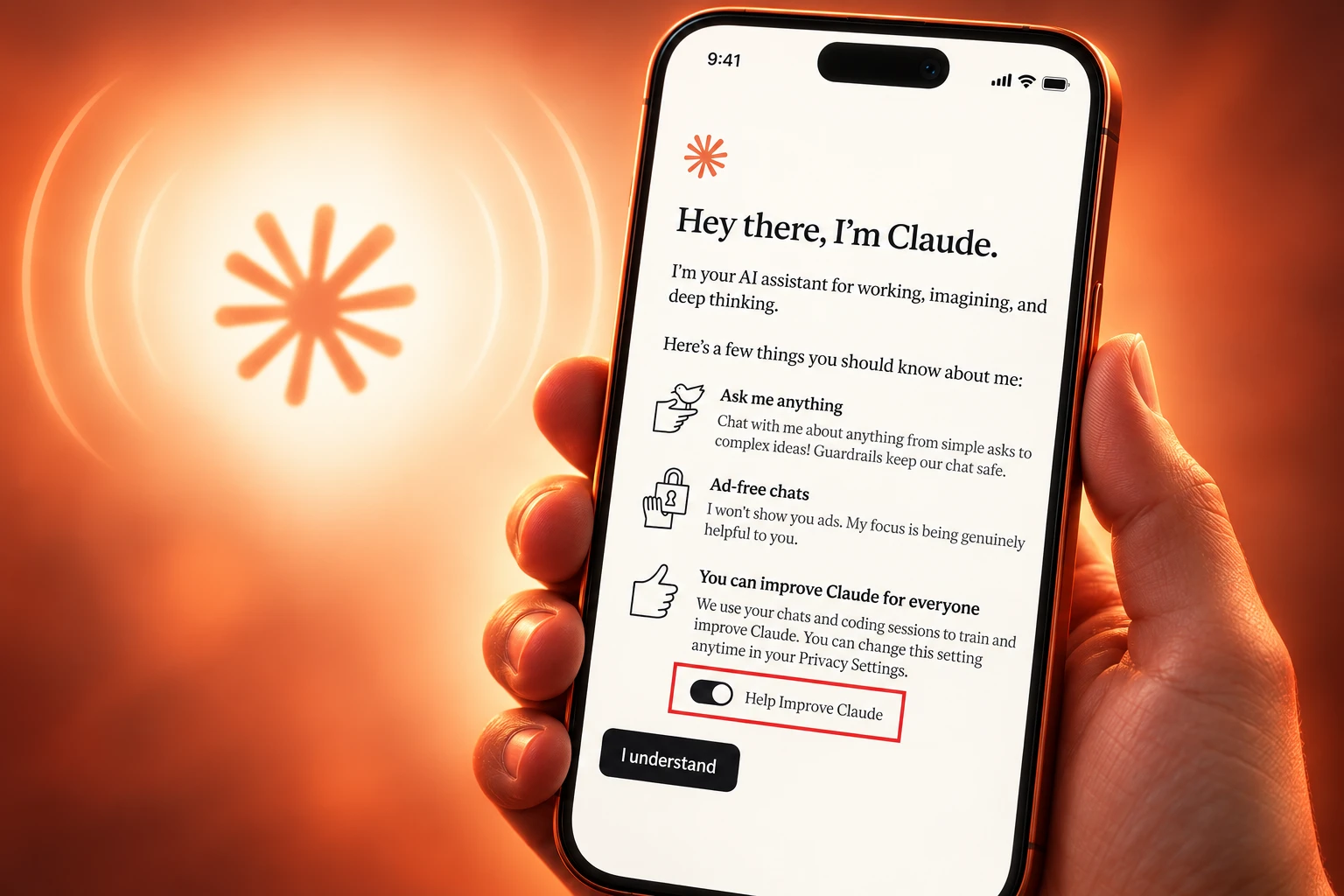
Anthropic has started asking Claude users to share voice recordings so it can train models on speech. The prompt appears when people use voice features and offers Allow or Not now. A matching Privacy setting starts off.
The request is a change in kind. For dictation on the mobile apps, Anthropic still says it deletes the recording after speech becomes text and does not train on the voice itself.
Claude Now Asks to Keep the Recording
The in-app copy is blunt. It asks users to let Anthropic use voice data to improve its models, and it says audio recordings and voice chat data help those models understand and respond to speech. It also says the choice can be turned off later, and that the data can be deleted in settings.
Allow us to use your voice data to improve our AI models.
Audio recordings and voice chat data help improve how Anthropic AI models understand and respond to speech. Turn this off or delete this data anytime in settings.
Anthropic, Claude voice prompt
Inside Settings, then Privacy, the matching line is labeled “Allow us to use your voice data.” The description under it reads: “For approved sessions, allow the use of your audio recordings and voice chat data to improve Anthropic AI models.” In the interface seen so far, that switch is off until someone taps Allow.
Voice has its own control. Anthropic already lets consumer accounts share regular chats and Claude Code sessions for model improvement, and the new voice option does not piggyback on that choice. You can share voice while keeping typed chats out, or share text while keeping the recordings out. Late September’s Claude Marketplace, which Anthropic billed with 2,000 connectors, is a separate product change; this prompt is about the audio itself.
Why Transcripts Are Not Enough
Typed Claude logs already capture words. A recording captures how those words were said, and that is the scarce input. Public web text can be crawled. Other people’s private spoken chats cannot, which is why a lab that already has billions of tokens still wants the microphone file.
Speech systems that look strong on clean English still stumble on overlapping talk, regional accents, and the messy timing of a real back-and-forth. A transcript strips the pauses, the “mm-hm,” the unfinished sentence, and the shift in pace when someone gets interrupted. Those cues are what a voice product has to get right if it is going to feel like a conversation instead of a dictation box.
WHAT A VOICE FILE CAN CARRY
- The words: The same prompt text Anthropic already stores as a chat, plus Claude’s spoken reply.
- The delivery: Accent, pitch, hesitation, talking speed, and the gaps between turns.
- The room: A second speaker, a child, a TV, or a colleague on speakerphone if the mic is live.
- The work: Anything a user says out loud after Claude reads mail, a calendar, or a Slack thread.
That last item is new in practice even if the legal form looks like a privacy toggle. Since July 2026, voice mode can reach connected apps. A user who opts in is not only donating how they pronounce a question. They may be donating a spoken pass over the contents of tools they already linked.
Dictation Still Says the Audio Is Deleted
Claude has two different ways to speak, and they are easy to mix up. Dictation lets you talk a prompt so the app can type it. Voice mode is a spoken conversation, with Claude talking back. Anthropic’s Privacy Center still treats dictation as a convert-and-discard path.
On that dictation page, Anthropic says it deletes the audio after converting speech to text. It also says, in plain words, “We do not use your voice for training our models.” If a user has already allowed chat training, the leftover text may still be used under that other setting. The recording, under that page, is not the training object.
Voice mode has been in the product since May 2025, when Anthropic began a mobile beta in English and described it as a way to talk to Claude with your hands busy. It later settled on Haiku for speed. On July 23, 2026, Anthropic opened voice to Opus and Sonnet as well, let people switch models mid-chat, and wired in tools such as Gmail, Google Calendar, Slack, Canva, and Notion. That upgrade also named French, German, Spanish, Hindi, Indonesian, Italian, Japanese, Korean, and Portuguese beside English.
For about a year after launch, the public privacy story on spoken input was still the dictation story: keep the text, drop the tape. The October 2026 prompt is the first time Anthropic has asked consumer accounts, in product copy, to let it keep the recording for training.
Five Years for Chats, Silence for Voice
The voice prompt does not say how long approved recordings stay on disk. That gap sits next to a chat policy Anthropic has already written down in detail. On August 28, 2025, it updated Consumer Terms for Free, Pro, and Max so people could choose to let chats and coding sessions improve Claude. Existing users had until October 8, 2025 to pick. New users saw the choice at signup.
If that chat setting is on, Anthropic applies a five-year hold if training is allowed, in a de-identified form, and only for new or resumed chats after the switch is flipped. The company said development cycles run 18 to 24 months, so a shorter stash would fall out of date before the next model ships. If the setting stays off, ordinary consumer retention stays on the short clock. Delete a chat and Anthropic says it leaves your history at once and is gone from back-end storage within 30 days.
CONSUMER RETENTION ANTHROPIC HAS WRITTEN DOWN
| Situation | How long Anthropic says it keeps the data |
|---|---|
| You delete a chat | Off history at once; back-end delete within 30 days |
| Chat or code training is on | De-identified copy, up to 5 years in training pipelines |
| Chat or code training is off | 30-day retention |
| A chat is flagged under the Usage Policy | Inputs and outputs up to 2 years; trust-and-safety scores up to 7 years |
| Thumbs-up or thumbs-down feedback | 5 years, unlinked from your user ID before use |
| Approved voice recordings | Not stated in the prompt or the new setting text |
Turning chat training off later stops new sessions from entering future training runs. Data already inside a run that has started, or inside a model that has already been trained, stays there. Anthropic has not said whether the voice toggle follows that same one-way door. Until it does, “delete anytime” is a product claim to test in settings, not a finished retention rule.
Voice Mode Can Reach Gmail and Slack
The July 2026 voice upgrade is why this toggle is not a toy-mic setting. Paid plans can talk to Opus or Sonnet, switch models during a session, and ask Claude to act in connected apps after it requests permission. Free accounts stay on Haiku and one connected app. The speech layer is still turn-based: Claude listens, pauses, then answers.
Spoken Work Is Not the Same as a Connector File
Anthropic’s training article draws a hard line on files. Raw content from connectors such as Google Drive, and from remote or local MCP servers, is not pulled into model improvement just because the account is linked. Paste that content into the chat, and it can be. Voice punches a hole in that line without changing the written rule. If Claude reads an email aloud and you answer out loud, the recording holds the spoken version. The file in Drive may stay out. The words in the air do not.
Incognito chats are still excluded from model improvement even when the main chat-training switch is on. The new voice prompt does not mention Incognito, and it does not say whether a voice session can be marked the same way.
Other Voices Can End Up in the Recording
A phone on the table does not know whose throat produced the sound. Kitchen talk, a partner on speaker, or a colleague walking in can land in the same file as the intended prompt. Anthropic’s personal data of people who are not users notice already covers people who never opened Claude and still show up in training material gathered from the public web. A live microphone is a more direct path for the same problem.
Voice audio is personal data. It becomes a stricter legal class in places such as the EU only if it is processed to identify a person, as a voiceprint would. Anthropic’s prompt talks about understanding and responding to speech, not about building a speaker ID system. That distinction matters, and it is still a distinction the company has to keep in the actual pipeline, not only in the marketing line on the dialog box.
Free, Pro, and Max Are in the Pool
The voice ask sits on the same consumer tracks as the 2025 chat-training choice. Claude for Work, Claude for Government, Claude for Education, and API traffic, including Amazon Bedrock and Google Cloud, stay under commercial terms. Anthropic trains on Free, Pro, and Max data when the setting is on, and it does not apply that default to those commercial products.
WHO THIS VOICE ASK COVERS
| Account type | Voice-training default | Separate chat and code toggle |
|---|---|---|
| Claude Free, Pro, and Max | Off, until Allow | Yes, independent of voice |
| Claude for Work (Team, Enterprise) | Outside this consumer prompt | Commercial terms, no default training |
| API, Bedrock, Vertex, Claude Gov, Education | Outside this consumer prompt | Commercial terms, no default training |
That split is clean on paper and messy on a phone that is used for both. A person who pays for Max at home and also has a work seat can flip the consumer voice switch without touching the company workspace. Security teams that already review the chat-training box now have a second control to inventory, and a second deletion path to prove. Other consumer assistants already expose extra audio switches of their own. ChatGPT’s data settings include separate audio and video options on top of “Improve the model for everyone,” and Live voice clips are described as kept for 30 days, then deleted with the chat unless security or legal rules require more. Gemini has a line for improving Google services with audio and Gemini Live recordings. Anthropic’s version is later, and it is at least a dedicated switch.
An Accidental Allow Can Be Undone
Anthropic has not said whether every Claude account sees the prompt or only some. The copies described so far match, and they all start off. Anyone who tapped Allow by mistake can reverse it in the same Privacy screen and delete voice data from settings, according to the in-app text.
HOW TO CHECK THE VOICE SETTING
- Open Claude: Use the app or the web account where you take voice calls.
- Go to Settings, then Privacy: The new line sits with the other training controls.
- Read “Allow us to use your voice data”: Leave it off to keep recordings out of training, or turn it on for approved sessions.
- Check the chat and Claude Code box too: Changing voice does not change that one.
- Delete if you already tapped Allow: The prompt says voice data can be removed in settings after the fact.
The useful test is not the label on the switch. It is whether a deleted recording actually leaves training queues, how long an approved file sits before that delete, and who inside a household or a company is allowed to flip the control. Two toggles mean two audit trails. A work tenant that wants voice off should treat the consumer setting as a seat-by-seat check, not a one-time policy memo.
WHAT WE KNOW
- The default: The voice setting is off in the interface described so far, and Allow is a choice.
- The split: Voice training is independent of chat and Claude Code training.
- The plans: The consumer Free, Pro, and Max track is the pool; commercial products stay on their own terms.
WHAT IS UNCONFIRMED
- Retention: Anthropic has not said how long approved voice recordings are kept.
- Scope: It has not said whether every account sees the prompt.
- The 5-year rule: It has not said whether the chat-training hold applies to audio files.
Users who want the spoken product to get better at their accent have a way to donate the tape. Users who do not can leave the switch off, and they should still look at dictation and voice as two different promises. Anthropic is asking for the recording it used to throw away. It has not yet said how long it will keep the ones it is allowed to hold.

Anker’s $94 MagSafe Dock Undercuts Apple on Prime Day

LG Will Sell the Apple-Designed Lock and Thermostat

Claude Asks to Keep Voice Recordings It Once Deleted

Jeep Bets One Grand Wagoneer Can Replace Two

Kortext Buys the Study Tool Already Inside Campus Software

Long Realty Drops Lundeen After the Flight 618 Arrest

Land Rover Pushes the Electric Defender Into the 2030s

Boox Picco Drops Phone Magnets for a Pocket Linux Reader

OPEC+ Holds October Oil Output After Six Paper Hikes

American Eagle Style Number on Tag – Decoding Clothing Label Information
-
 BUSINESS1 month ago
Long Realty Drops Lundeen After the Flight 618 Arrest
-
 AUTO1 month ago
Land Rover Pushes the Electric Defender Into the 2030s
-
 NEWS1 month ago
Boox Picco Drops Phone Magnets for a Pocket Linux Reader
-
 BUSINESS1 month ago
OPEC+ Holds October Oil Output After Six Paper Hikes
-
 LIFESTYLE3 years ago
American Eagle Style Number on Tag – Decoding Clothing Label Information
-

 GAMING4 weeks ago
Kalshi Asks 11 Judges to Undo a Sports-Swap Split
-
LIFESTYLE3 years ago
How to Remove Sewn-In Tags – Techniques for Tag Removal from Clothing
-

 NEWS4 weeks ago
ChatGPT Images 2.5 Splits Image Work Into Two Speeds