LIFESTYLE
How to Remove Sewn-In Tags From Shirts, Knits, and Lace
Learn how to remove sewn-in tags by cutting only the label stitches, trimming a tag caught in the seam, and changing the cut for silk, pile, lace, and knits.

That stiff label at the back of your neck scratches every time you turn your head, and pulling on it will not make it let go. Sewn-in tags come off cleanly when you cut the thread that holds them and you leave the cloth alone.
Some labels are sewn on with their own stitches, and others are caught in the seam that holds the garment together. The steps below separate those two cases, then show how to lift a label stitch by stitch, when to trim instead, and how silk, pile, lace, and knits change the cut.
Two Ways a Clothing Label Is Attached
Turn the garment inside out on a table, under a lamp that hits the stitches rather than the room. Navy, black, and busy prints hide thread, so give your eyes a minute before a blade comes near the cloth. Look at the edge of the label and at the seam beside it, including a side seam if the neck looks bare.
A label with its own thread shows a short line of stitches that stops at the label. A label caught in the garment has the neck seam, the side seam, or an overlock running straight through it, with no separate row you can lift. Stacked ribbons for fiber, origin, and wash words need that same look on each ribbon.
| What you see | What you do |
|---|---|
| A stitch line that stops at the label | Unpick those stitches, one at a time |
| The garment seam running through the label | Trim the label close and leave the seam |
| A fused tab with no thread to lift | Cut the loose end and leave the sealed bit |
| A hard shop tag with a pin or a lock | Take the garment back and let the shop remove it |
If you cannot name the thread you are about to cut, leave it. One or two snips that let the label lift mean you are on the label’s thread. A label that stays put while the seam puckers is part of the garment, and that one gets a trim.
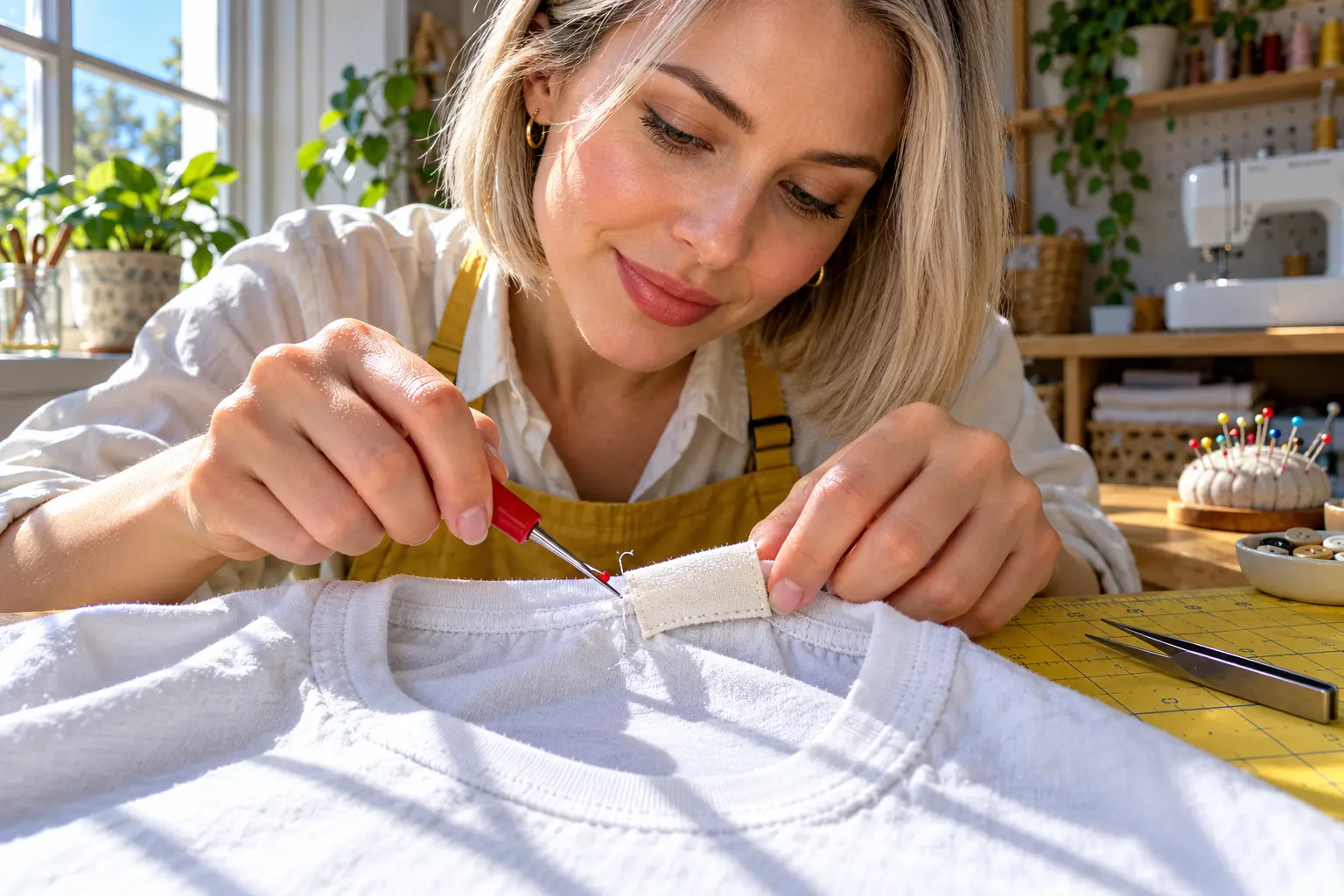
Tools for Cutting Thread and Sparing Cloth
You only need a few tools, and the shape of the seam ripper matters more than the name on the handle. Set them out before you start so you are not hunting for tweezers with the blade already in the stitch.
WHAT TO HAVE WITHIN REACH
- The ripper: A seam ripper has a sharp point, a small ball on the short fork, and a blade sitting in the curve between them.
- The ball: Clover’s standard ripper is used by placing the longer tip under the thread and pushing forward, and it includes a small ball to protect the fabric.
- The brush tip: A Clover Grip Fit handle adds a textured tip that brushes cut threads off the surface, which saves you from picking every fleck by hand.
- Small scissors: Fine embroidery scissors snip one thread you can see, and they are the better choice when the label is buried in a seam.
- Tweezers: Pointed tweezers pull the cut ends out once the stitch is broken.
- A lamp: Put the light on the thread, especially on dark cloth where the stitch and the fabric are almost the same color.
On a long seam inside a sewing project, the ball rides against the cloth so the point stays off it. A clothing label lies flat on the shirt, with no open seam allowance for that ball to ride in, so a fast push can send the point into the garment. For a label you pick one stitch with the point, and you rest the tool on the label rather than sliding it under the shirt.
How to Unpick Sewn-In Tags on Their Own Stitches
Use this path only after you have seen a stitch line that belongs to the label. A flat table keeps the cloth from shifting the way it does in your lap.
- Smooth the area and find a corner where one stitch stands clear of the others. The top corner is a steady place to start.
- Slide the point under that single thread, with the body of the ripper resting on the label.
- Lift until the thread cuts, then stop and look at what came loose.
- Draw the broken thread out with tweezers or a pass of the brush tip. A label that starts to lift is the sign you want.
- Move along the label one stitch at a time, and skip any thread that also holds the garment seam.
- When the label comes free, clear the remaining bits so they do not scratch later.
Holly Simpson, who runs the repair workshop Carnation Club in Castlemaine, Victoria, starts at one end of the stitch line, lifts a few threads with the unpicker, and pulls the top thread until it releases. On a plain cotton label that pull finishes the job. Strong thread and a second or third row take longer, and yanking the label to speed them up is what tears the shirt.
When to Trim a Clothing Label Close
Trimming is the right move when the seam that holds the shirt also holds the label. Small sharp scissors cut the ribbon as close as you can get without touching the seam thread. Hold the label a little away from the cloth while you snip, so the blade meets tape and not shirt. A short remnant is safer than a hole, and a stiff cut edge can still scratch until you deal with it.
Some tabs are melted into the seam rather than sewn. Cut the loose part off and leave the tiny sealed piece inside the seam, where it will not show. A hang tag on a string gets the string cut away from the cloth. A plastic fastener stem can be snipped in the middle so each side slides out. A hard store tag with a lock or a pin is the shop’s to remove, so take the garment back rather than forcing the pin through the cloth.
If you would rather not cut at all, hem tape can stick a flapping label flat on a sturdy woven shirt. Use an iron only on cloth that can take heat. On silk or anything with a finish you cannot replace, skip the iron and stay with the trim or the stitch-by-stitch unpick.
Fabric Changes for Silk, Pile, Lace, and Knits
Once the label has its own stitches, the cloth decides whether you cut every stitch or only some of them. The counts below come from seam work on these fabrics, and they apply when you can reach the label’s thread from both sides.
Silk and Other Slippery Cloth
Soft silk skids when you push a ripper the way you would on cotton. Olga Balasa, a sewist with 30 years of practice, cuts every third or fourth stitch on one side of the silk, pulls the thread out from the other side, and brushes the cut bits off the cloth.
That pull stays kind only while the cloth is stronger than the thread. When the sewing thread is thicker than the silk, the fibers can break and you get holes. Chiffon, habotai, georgette, and organza belong with the scissors, not the ripper.
SHEER SILK
Trim chiffon, habotai, georgette, and organza. Do not unpick them, because a thread thicker than the cloth can break fibers and leave holes.
If you cannot tell which silk you are holding, small scissors and a close cut are the whole method.
Fur, Velvet, and Pile Fabrics
Fur and velvet cannot take a normal sweep of the ripper, because the blade cuts the pile along with the thread. Work from both sides, and cut far less often than you would on a cotton seam.
- Count four or five stitches and leave them uncut.
- Slide the tip under the sixth stitch and cut only that one.
- Pull the freed thread out of the seam.
- Turn the cloth over and repeat on the other side until the label thread is gone.
Keep the blade out of the hairs. If the label on a velvet jacket is caught in the garment seam rather than sitting on its own stitches, trim it and do not run this sequence through the pile at all.
Lace and Open Weave Labels
Lace thread can match the cloth so closely that it disappears until you have it between your fingers. Pull the thread a little, the way you start a gather, and cut it at the far end of that gather. A longer piece then slides out of the open weave. Turn the lace and do the same on the other side.
WHEN THE THREAD HIDES
Gather first, then cut at the far end, so the thread you cut is one you can see between your fingers.
On a lace camisole, that gather-and-cut is enough for a label stitched along one edge. If the lace itself is what holds a seam together, trim the label and leave those lace threads where they are.
Knit Necks and Coverstitch Labels
Many T-shirt necks tuck the label under a stretch finish called coverstitch. On the outside you see straight rows. On the inside you see loops, and those loops let go in one direction only.
- Outside: Two straight rows run along the neckband, or three on some machines.
- Inside: Loops sit under those rows, and they release in one direction only.
If the label is only caught under that stitching and the neckband does not depend on it, cut both needle threads at one point and again about five or six stitches along. Pull the looper thread in the direction that lets go. It will not move the other way. After the looper thread is out, the needle threads pull free. If those rows are the seam that holds the neck together, trim the label and leave the coverstitch alone. The same limit applies to an overlock seam, because cutting its needle threads lets the looper threads fall away and opens the seam, so a serged-in label gets a trim.
The Stub Left After You Cut a Tag
A flush cut with scissors can leave a short piece of woven tape in the seam. That stub can feel sharper than the full label, and the scratch that comes back is that remnant. The shirt did not grow a new tag.
If the remnant bothers your skin, go back with the ripper and lift that last bit one stitch at a time. People who cannot bear labels keep a small pair of scissors and a seam ripper in a dresser drawer and do the neck before the first wear. On a child’s shirt the same stub sits on thinner skin, so run a finger around the inside of the collar when you think you are done.
Care Instructions to Save Before You Cut
Photograph the care label before the first snip, or drop the ribbon in an envelope with the name of the shirt. You will want those words on laundry day, and they are easy to lose once the label is in the bin.
WHAT THE PHOTO SHOULD SHOW
- Washing: The label says hand or machine, plus a water temperature if hot water would harm the cloth.
- Bleach: Look for no bleach line, the words “Only non-chlorine bleach, when needed,” or the words “Do not bleach.”
- Drying: Machine or another method, with a heat note only when high heat would harm the cloth.
- Iron: Ironing words show up when the garment needs regular ironing, and a “Do not iron” line shows up when a hot iron would harm it.
- Warnings: Lines such as “Wash with like colors” or “Wash separately” tell you the item can stain its neighbors.
Those lines are what the Care Labeling Rule for garments makes manufacturers and importers attach, and the label is supposed to stay readable for the useful life of the piece, a duty on the books since 1971. The FTC voted on July 21, 2021, to keep the rule after comments from people who use the labels to make clothes last.
You are free to cut that label off a garment you already own. The rule binds the manufacturer and the importer at the time of sale, which is why the photo matters more than keeping the ribbon. Care words can sit on the back of the brand label when only one end is sewn down and both sides are easy to see. Fiber content and country of origin are separate markings, so photograph the whole cluster before any ribbon comes off.
Mistakes That Put a Hole in the Shirt
- Pulling the tag: The cloth stretches or a seam opens before the thread gives up.
- Cutting the seam: You opened the shirt instead of the label.
- Point into the cloth: The sharp fork facing the garment punches a hole, so rest the tool on the label.
- A fast rip on sheer silk: Chiffon, habotai, georgette, and organza can hole when the thread is stronger than the cloth.
- A sweep across velvet: The pile comes off with the thread if the blade drags through the hairs.
- Heat on a print: A flame or a hot scraper can melt synthetic fiber around a printed mark, and it does not take a woven tag off any faster.
If the point does nick the cloth, stop and do not pull the cut yarn. On a woven shirt, a few hand stitches in matching thread can close a tiny hole. On a knit, a cut loop can run when you tug it, so leave the end alone and take a hole you can see to someone who mends knits.
Frequently Asked Questions
Can You Remove a Care Label From Clothes You Own?
Yes, you can remove a care label from clothes you already own. A two-piece set sold as one unit needs only one care label, attached to the main piece, when every piece takes the same care, so look at the jacket or the dress before you decide the other piece never had wash words of its own.
What if the Seam Ripper Already Opened a Seam?
Resew any seam you opened, with a small backstitch at each end, before the shirt goes in the wash so the gap does not travel. A tiny nick in woven cloth can wait for a few hand stitches in matching thread, and a cut loop on a knit should be left for someone who mends knits rather than pulled.
How Do You Deal With a Printed Tagless Label?
Leave a printed tagless label in place. Care words printed on the cloth are meant to stay readable for the life of the garment, and scraping the ink can rough the fiber. If that print feels stiff on your skin, cover it with soft fabric tape instead of trying to peel it.
Will the Neck Look Odd After the Label Is Gone?
The old stitch holes sit on the inside of the neck, where they do not show while you wear the shirt. If the cloth looks puckered, a light press on a setting the fabric can take will smooth it. Keep the iron off any spot where a thread end is still sticking up, or you can press that end into a flat shiny mark.
Should You Remove Tags Before You Give Clothes Away?
Take off a scratchy brand label if you can do it without a hole, and leave the care label or pass along a photo of the wash words. The next person cannot guess a warning such as “Do not bleach” from the fabric alone. On a child’s shirt you are giving away, run a finger around the neck after you finish so no stiff stub remains.
You are finished when the label is gone and a finger along the inside of the neck finds no stiff edge and no cut yarn. Keep the photo of the wash words where you will see it on laundry day.


Anker’s $94 MagSafe Dock Undercuts Apple on Prime Day

LG Will Sell the Apple-Designed Lock and Thermostat

Claude Asks to Keep Voice Recordings It Once Deleted

Jeep Bets One Grand Wagoneer Can Replace Two

Kortext Buys the Study Tool Already Inside Campus Software

How to Remove Sewn-In Tags From Shirts, Knits, and Lace

Long Realty Drops Lundeen After the Flight 618 Arrest

Boox Picco Drops Phone Magnets for a Pocket Linux Reader

Land Rover Pushes the Electric Defender Into the 2030s

Kalshi Asks 11 Judges to Undo a Sports-Swap Split
-
 BUSINESS2 months ago
Long Realty Drops Lundeen After the Flight 618 Arrest
-
 NEWS2 months ago
Boox Picco Drops Phone Magnets for a Pocket Linux Reader
-
 AUTO3 months ago
Land Rover Pushes the Electric Defender Into the 2030s
-
 GAMING2 months ago
Kalshi Asks 11 Judges to Undo a Sports-Swap Split
-
 LIFESTYLE3 years ago
American Eagle Style Number on Tag: How to Read Every Line
-

 BUSINESS2 months ago
OPEC+ Holds October Oil Output After Six Paper Hikes
-

 BUSINESS2 months ago
Washington’s Ban Aims at Canada’s Dairy and Liquor Boards
-

 NEWS2 months ago
swXtch.io Lets a Chat Deploy Live Media Stacks