
BUSINESS
Washington’s Ban Aims at Canada’s Dairy and Liquor Boards
U.S. import bans from Sept. 29 target provincial liquor stores and dairy permits, not the 0.25 percent of Canadian sales the lists cover.

President Donald Trump signed five proclamations on Sept. 8 that will bar many Canadian spirits, some dairy goods and motorbikes from the United States starting Sept. 29. The lists are short. The targets are not.
The texts name provincial liquor stores that pulled American bottles last year, and dairy import permits that still keep U.S. cheese out of Canadian grocery aisles. Ottawa’s counter-tariffs came into force the same morning. No new talks are on the calendar.
Five Proclamations and a Sept. 29 Deadline
The White House published five proclamations under Section 338 of the Tariff Act of 1930, a 1930 tool that lets a president add duties of up to 50 percent and, if the other country keeps the practice, shut the goods out. The same statute backed the 50 percent extra duties that took effect on Aug. 22 after talks failed. Those duties apply even to goods that qualify under the U.S.-Mexico-Canada Agreement, and they stack on metal duties already in place.
Import bans take effect at 12:01 a.m. eastern time on Sept. 29. Product swaps on the 50 percent list take effect on Sept. 15. Whey, cane molasses and non-alcoholic beer move from the duty list to a closed door. So do malt beer, a long run of wine, rum, vodka and other spirits, plus motorbikes and mopeds. Cheeses and cheese substitutes stay legal to enter, at a higher tax. All-terrain vehicles, motorboats, golf carts, some paper, furniture, mattresses, hides, switchboards and some iron and aluminum goods join the 50 percent list. Rock salt and cement come off it.
THE NEW U.S. MEASURES
| Canadian product | U.S. action | Starts |
|---|---|---|
| Whey, cane molasses, non-alcoholic beer | Import ban | Sept. 29 |
| Malt beer, wine, rum, vodka and other listed spirits | Import ban | Sept. 29 |
| Motorbikes and mopeds | Import ban | Sept. 29 |
| Cheeses and cheese substitutes | 50% extra duty added | Sept. 15 |
| All-terrain vehicles, motorboats, golf carts | 50% extra duty added | Sept. 15 |
| Rock salt, cement | Removed from the 50% list | Sept. 15 |
U.S. Trade Representative Jamieson Greer called the bans a “natural consequence of Canada’s continued discriminatory treatment of crucial American exports.” A senior official, speaking to reporters without being named, said Washington chose bans over more duties because Canadian provinces had already barred American alcohol from government-run stores. “Canada set this precedent of banning things,” the official said.
How Provincial Stores Shut Out U.S. Alcohol
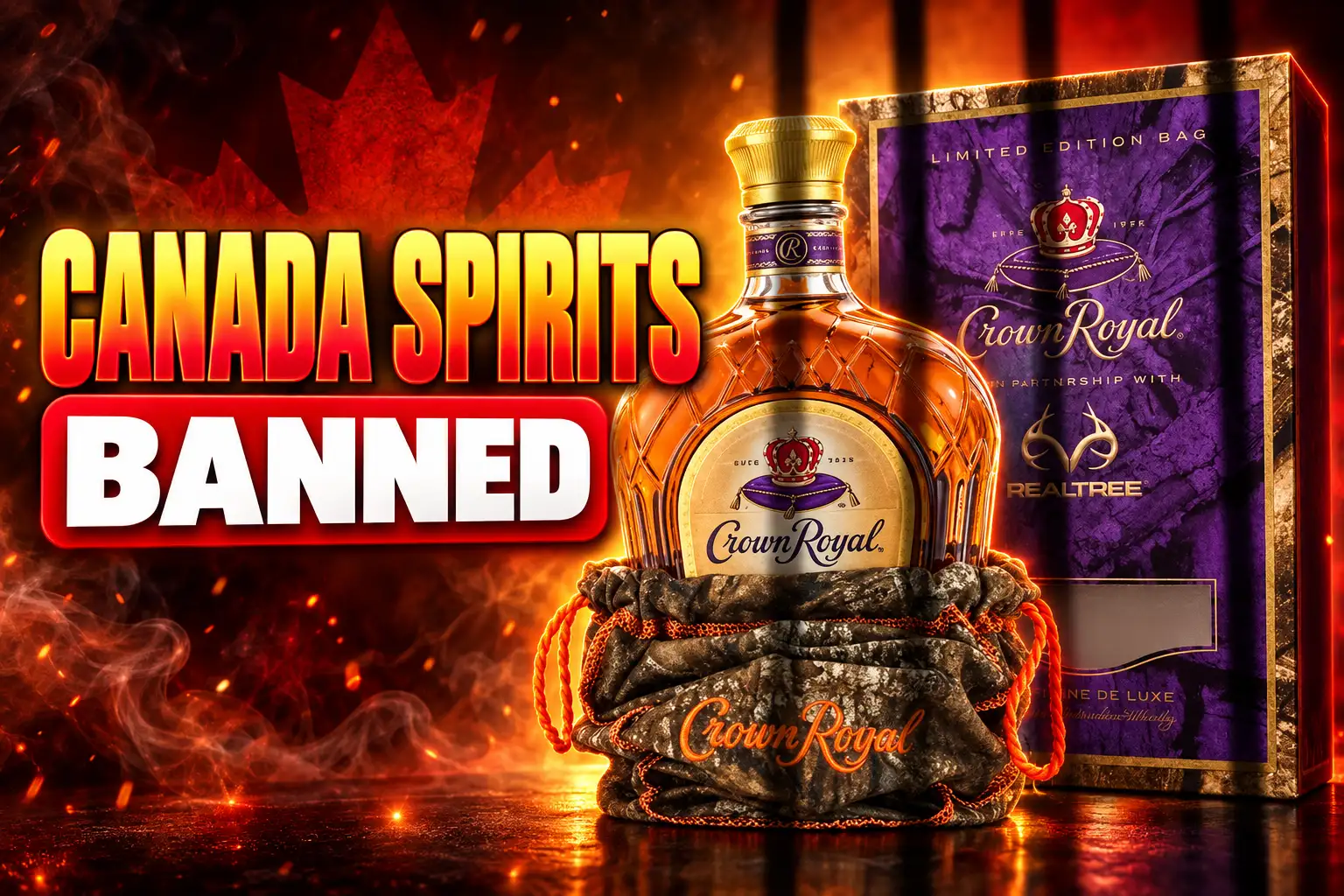
The alcohol ban is a reply to Crown liquor boards, not to Canadian distillers. In March 2025 every province and territory stopped buying, distributing or selling U.S. beer, wine and spirits while leaving other countries on the shelf. Ontario’s Liquor Control Board cancelled orders on March 4, 2025, and stripped U.S. bottles from stores and websites. Quebec told the Société des alcools du Québec the same day to clear shelves and cut off grocery stores, bars and restaurants.
Only Alberta and Saskatchewan later put American alcohol back, in June 2025. Saskatchewan then added a 50 percent levy on those bottles, announced on Aug. 27 and effective Sept. 8, the morning Canada’s federal counters also landed. The Sept. 8 U.S. alcohol proclamation cites that levy as proof Canada “maintained or increased” the practice after the 50 percent U.S. duties took hold.
THE ALCOHOL WAR SINCE MARCH 2025
- March 4, 2025: Ontario and Quebec pull U.S. alcohol from Crown stores; other provinces and territories follow.
- June 2025: Alberta and Saskatchewan lift their bans; the other provinces keep theirs.
- July 20, 2026: Trump signs Proclamation 11046, setting a 50 percent extra duty on listed Canadian goods over the liquor-board bans.
- August 18, 2026: A three-day pause starts after Canada says it will deal; the pause lapses when talks die on Aug. 21.
- August 22, 2026: The 50 percent duties take effect at 12:01 a.m. eastern time.
- August 27, 2026: Saskatchewan announces a 50 percent levy on U.S. alcohol, effective Sept. 8.
- September 8, 2026: Trump signs the import-ban proclamation; Canadian federal counters also start.
The July 20 finding puts a number on what those store bans did. Comparing March 2025 through February 2026 with the same stretch a year earlier, the White House recorded an 81 percent drop in U.S. alcohol sales into Canada, from about $718 million to about $137 million. Total alcohol imports into Canada fell by nearly 12 percent, yet shipments from other countries rose by more than $170 million, with the European Union accounting for more than $100 million of that gain. Imports from Chile, Japan, Argentina, Ireland, New Zealand and Australia rose between 13 percent and 26 percent.
Canada is discriminating in fact against the commerce of the United States by banning the purchase, distribution, or retailing of U.S. alcoholic beverages while not banning or similarly restricting such products from other countries.
Donald J. Trump, Proclamation 11046, July 20, 2026
Quebec Premier Christine Fréchette has already said the SAQ ban stays until Quebec judges a deal fair, and that Ottawa does not decide when U.S. bottles return. That is why a federal trade truce would still need premiers. It is also why a U.S. ban on Canadian beer and whisky is the matching move the provinces invited, even if Canadian distillers now lose the southbound shelf they still had.
Grocery Chains Stay Locked Out of Cheese Permits
Dairy is the other named fight, and whey is only the visible slice. Canada’s supply management system sets farm quotas, sets milk prices, and caps imports. U.S. farms have tariff-free room equal to 3.5 percent of Canada’s dairy market. Shipments above that face levies of 200 percent to nearly 300 percent. Trump has called that system unreasonable for years. The live dispute is narrower: who may use the low-tariff cheese permits Canada already opened under the current North American pact.
Al Mussell, a fellow at the C.D. Howe Institute, wrote in August that Canada’s cheese quota fill rates of 97 to 99 percent in 2025 under WTO, CETA, CPTPP and CUSMA access show the volume is being used. Washington’s complaint, he wrote, is less about empty quotas than about higher-value cheeses and about who is allowed to hold the permits. Global Affairs Canada hands those permits to processors and distributors with a recent history in the cheese trade. Retailers such as Loblaws, Walmart and Costco are left out of the CUSMA cheese allocation, a point the U.S. trade office has repeated in its National Trade Estimate.
WHO HOLDS CANADA’S CHEESE PERMITS
- The farmers: Dairy producers own milk quotas and get a pooled price, but they are generally ineligible for cheese import permits.
- The processors: Plants receive most CUSMA cheese-of-all-types and industrial-cheese allocations on a market-share basis, which protects how milk is steered into Canadian vats.
- The grocers: Large retailers cannot draw on the U.S. cheese quota, which is the change U.S. exporters have asked Ottawa to make.
- The over-quota wall: Once the small tariff-free slice is filled, extra cheese faces levies of 200 percent to nearly 300 percent.
Dairy Farmers of Canada says the current pact is already working for American exporters. U.S. dairy sales into Canada rose from C$423 million in 2019 to C$1.06 billion in 2025, a 150 percent increase, the group said in July, and it called supply management a system covered by the deal Trump signed in his first term. Mussell put Canadian cheese exports the other way at just over $80 million. That gap is why a whey ban and a cheese tariff can sting politically in Quebec and Ontario even when the dollar totals look modest. Quebec’s premier has called supply management non-negotiable. Scott French, an economics lecturer at the University of New South Wales, said Washington has aimed at “significant industries” for Canada, including its politically influential dairy businesses.
Giving grocers the permits would help U.S. exporters. It would also hand those chains more leverage over Canadian plants and the milk boards that feed them. That is the concession Ottawa has so far refused to put on the table, and it is the concession the Sept. 8 dairy proclamation is built to extract.
$90 Million in Motorbikes Joins the Ban List
Motorbikes, including mopeds, are the third closed door. UN figures compiled by Trading Economics put Canada’s 2025 motorcycle exports to the United States at $90 million, beside $687 million in alcoholic spirits and $269 million in dairy products. All-terrain vehicles are not banned; they join the 50 percent duty list on Sept. 15. The motorcycle line is small next to autos, steel and energy, which is the point. It is a consumer good with a factory map in Quebec and a dealer network that U.S. riders will notice.
CANADA’S 2025 SALES INTO THE U.S.
- Alcoholic spirits: $687 million, the largest of the three banned-group figures, and the one most tied to Crown store retaliation.
- Dairy products: $269 million, with whey moving to a ban and cheeses moving to a 50 percent extra duty.
- Motorbikes: $90 million, now scheduled for a closed border on Sept. 29 rather than a higher tax.
- Share of the flow: Stephen Brown, chief North America economist at Capital Economics, put the whole import ban at 0.25 percent of Canada’s exports to the United States.
Those three lines sum to $1.046 billion. Deborah Elms, a trade expert at the Hinrich Foundation, put the early hit at around $1 billion and called the effect “modest” in total, though “strong” for any Canadian firm whose buyers are in the United States. Brown’s reading was blunter. “Trump’s willingness to impose an import ban is further evidence, if it were needed, that these latest measures are about inflicting economic pain rather than raising revenue,” he said. More than two-thirds of Canada’s exports already go to the United States, so a thin slice still lands on plants that have few other doors.
The dairy door is not fully shut. Whey is banned; cheese can still cross at the new 50 percent rate. That distinction got lost in some first-day claims that “all dairy” was barred. It was not. The political weight sits in the permit fight, not in a total embargo on milk protein.
After Carney Suspended Talks, the Bans Arrived
The bans landed the morning Canada’s own counters took effect, and 18 days after Prime Minister Mark Carney pulled his negotiators out of Washington. On Aug. 21 he said last-minute U.S. terms were “unfair, uneconomic, and called into question the reliability of any deal,” and he sent the team home. Greer said Canada had declined to close a deal “under the terms agreed earlier this week” and had walked back commitments. A three-day pause on the 50 percent duties lapsed at 12:01 a.m. on Aug. 22.
Carney had been ready, officials around the talks said, to drop Canada’s older counters on steel, aluminum and autos and to ask premiers to put American alcohol back on shelves if Washington cut its metal and car duties by enough. The U.S. side wanted more dairy access, lumber movement, and, in the Canadian account, last-minute asks on streaming rules and French-language labelling. Carney’s public line on Aug. 22 was short: the United States “asked too much, and they offered too little.”
Finance Canada then posted the reply that started on Sept. 8: dollar-for-dollar tariffs on $27.6 billion of U.S. goods, at 15, 25 and 50 percent, matched to the U.S. rate on each product. The list leans on steel and aluminum, dairy, appliances, farm equipment, pulp and paper, and electronics. Goods at 50 percent include steel and aluminum products that had sat at 25 percent, plus furniture and clothing. Cheese and other dairy sit at 25 percent on the way north.
Dominic LeBlanc, the minister who handles Canada-U.S. trade, called the new U.S. bans “unjustified.” He said he was in contact with Greer and would work “in good faith” if Washington is ready. “Our core focus is on what we can control: building strength at home, diversifying our partnerships abroad, and building Canada strong for all Canadians,” he said. Greer and LeBlanc had already spoken in the days before the proclamations and were expected to speak again. That is contact. It is not a negotiation with a date.
No Talks on the Calendar Before Sept. 29
The White House also told the trade office and the General Services Administration to pull Canadian-origin goods off GSA Multiple Award Schedules, which handle more than $50 billion in federal buying. Trump wrote that Canadian governments had shut American firms out of their own procurement, and that there would be “NO RECIPROCITY – NO ACCESS” until Ottawa restored “full and fair reciprocity.” A senior official said that work was still “in progress.” On Sept. 7 Trump warned Bombardier it would lose the U.S. market unless it built in the United States. An official said a separate threat to lift tariffs on Canadian cars from 25 percent to 50 percent on Jan. 1 still stands.
Elms said Canada will likely “hold course for now” and adjust business supports, and that the wording in the proclamations “isn’t helpful in getting to the negotiating table.” French said the fight will be “costly for both sides due to the historical level of integration of the North American economy,” and that shoppers on both sides of the border will be “the biggest losers.” Mussell flagged a deeper problem for anyone who still treats the current pact as a referee: Washington is using Section 338 even after an earlier CUSMA dairy ruling went Canada’s way.
There’s always a cost to action. But it doesn’t come close to the cost of standing still.
Mark Carney, Prime Minister of Canada, Sept. 8, 2026
Carney said the same day that moving Canada off the United States as its largest trading partner “will come at a cost.” The next cost on the calendar is mechanical. At 12:01 a.m. eastern time on Sept. 29, listed Canadian whisky, beer, whey and motorbikes stop at the U.S. border unless someone puts talks back on the book before that hour.

Anker’s $94 MagSafe Dock Undercuts Apple on Prime Day

LG Will Sell the Apple-Designed Lock and Thermostat

Claude Asks to Keep Voice Recordings It Once Deleted

Jeep Bets One Grand Wagoneer Can Replace Two

Kortext Buys the Study Tool Already Inside Campus Software

Long Realty Drops Lundeen After the Flight 618 Arrest

Boox Picco Drops Phone Magnets for a Pocket Linux Reader

Land Rover Pushes the Electric Defender Into the 2030s

OPEC+ Holds October Oil Output After Six Paper Hikes

American Eagle Style Number on Tag – Decoding Clothing Label Information
-
 BUSINESS1 month ago
Long Realty Drops Lundeen After the Flight 618 Arrest
-
 NEWS1 month ago
Boox Picco Drops Phone Magnets for a Pocket Linux Reader
-
 AUTO2 months ago
Land Rover Pushes the Electric Defender Into the 2030s
-
 BUSINESS1 month ago
OPEC+ Holds October Oil Output After Six Paper Hikes
-
 LIFESTYLE3 years ago
American Eagle Style Number on Tag – Decoding Clothing Label Information
-
LIFESTYLE3 years ago
How to Remove Sewn-In Tags – Techniques for Tag Removal from Clothing
-

 GAMING1 month ago
Kalshi Asks 11 Judges to Undo a Sports-Swap Split
-

 NEWS1 month ago
swXtch.io Lets a Chat Deploy Live Media Stacks