
SPORTS
Where Was Roger Federer Born?
Where Was Roger Federer Born? Basel, on August 8, 1981, at the cantonal hospital, before the family homes in Birsfelden, Riehen, and Münchenstein.

You want a city you can point to, and you also want the house where the rackets were actually kept. Roger Federer gives you both, a few kilometers apart, on the edge of Switzerland where France and Germany meet.
Where was Roger Federer born is a one-line fact: he was born in Basel, Switzerland, on August 8, 1981, and the ATP still lists Basel as his hometown, with the family addresses in neighboring towns. The hospital sat in the city. The houses did not all sit there with it.
What follows is the birth record, the towns in the order the family used them, the clubs where he started, the weeks he spent as a ball boy, the home titles, and the tram that carries his name.
Roger Federer’s Birthplace in Basel
The birth itself belongs to the city, not to a suburb that later claimed him. On August 8, 1981, he arrived at the Basel Cantonal Hospital, which stands in the canton of Basel-City, and that is the place every short biography is pointing at when it prints one word.
His father, Robert Federer, is Swiss, from Berneck in the Rhine valley of St. Gallen. His mother, Lynette, is South African, from Johannesburg. Player bios list Swiss and South African nationality through those two lines, and he has one sister, Diana.
THE BIRTH RECORD
- The date: August 8, 1981, at the Basel Cantonal Hospital in Basel-City.
- The parents: Robert Federer, from Berneck in St. Gallen, and Lynette Federer, from Johannesburg.
- The sister: Diana, who later helped at the family’s home tournament alongside their mother.
- The hometown line: Basel, which is the city the ATP bio still prints.
He has never treated that hospital line as a technicality. In the interview where he calls Basel home, published on March 30, 2012, he tied the city to his dialect, his birth, and the routes he still knew by heart.
“For me, Basel is very clearly my home. After all, I speak Basel German, was born and grew up there, and know every route to take by bus, car, bike or on foot.”
Roger Federer, Credit Suisse interview published March 30, 2012
He added, in the same conversation, that not living there for a while changed nothing: Basel was still his home. The sentence covers the city and the towns around it in one breath, which is how his father describes the family’s own map.
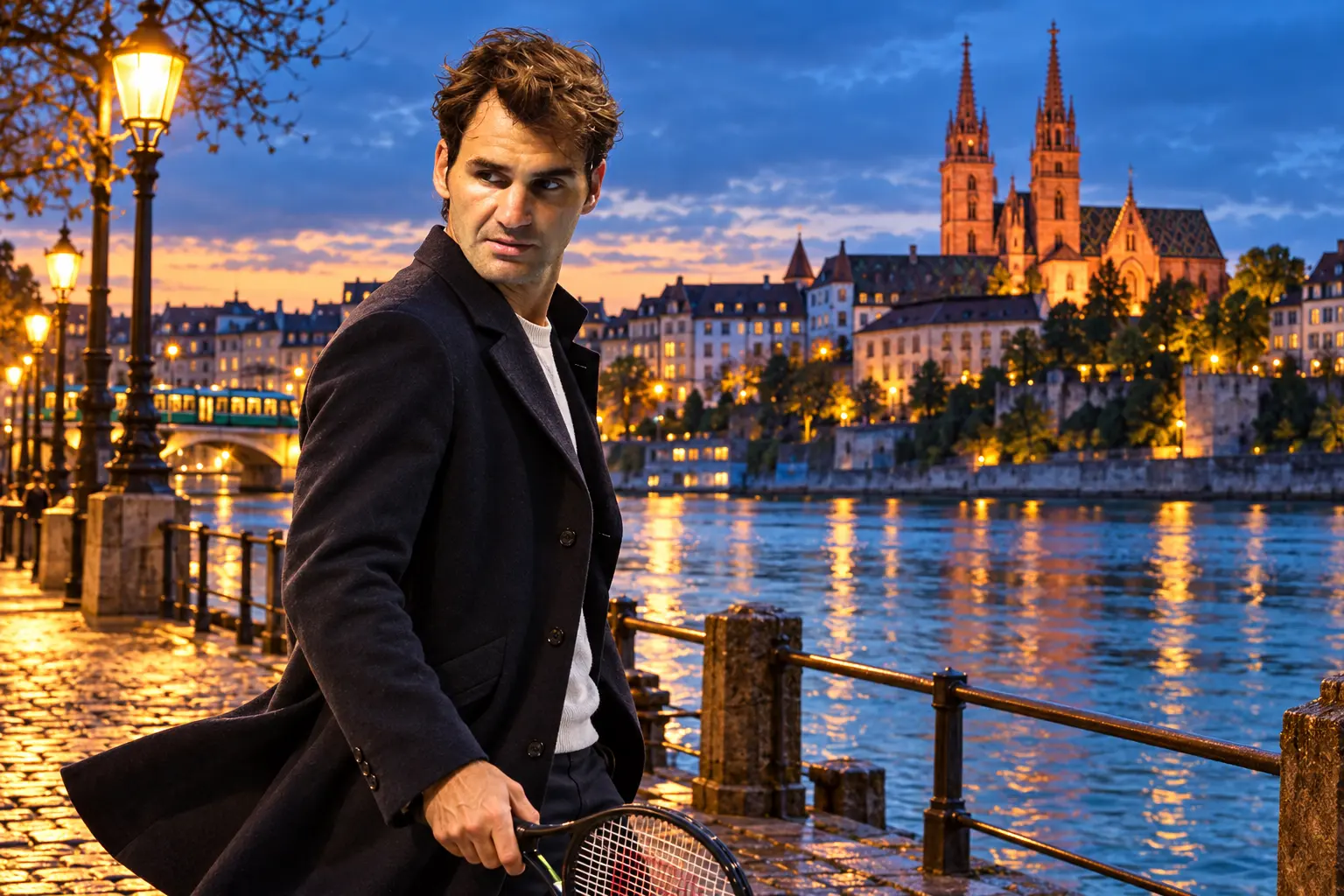
Birsfelden, Riehen, and Münchenstein
A local argument has followed him for years, because Basel-City and the half-canton of Basel-Country keep separate identities, and readers of the Basler Zeitung once complained when the paper called him simply a man of the city. Robert Federer has answered that quarrel in plain terms. For people who moved in, he said, the line was not a big matter, and Roger did not see himself as belonging to either side so much as to the whole region.
The addresses still fall in a clear order, and the order is what the one-word answer leaves out.
| Town | Canton | When the family was there |
|---|---|---|
| Birsfelden | Basel-Country | The parents’ home at the time of the birth |
| Riehen | Basel-City | The next home, inside the city canton, near the French and German borders |
| Münchenstein | Basel-Country | A row house in the Wasserhaus neighborhood from the time Roger was 10 |
Robert Federer’s memory of the last move is specific: they came to Münchenstein when Roger was 10. From that row house to St. Jakobshalle, the indoor hall used every autumn by the home tournament, the walk took 30 minutes. The hall itself sits in Basel-Country, and the soccer stadium beside it sits in the city, so even the sports ground straddles the same line the family refused to treat as a border.
Riehen is the town in that list that later hosted a family occasion of its own, and Münchenstein is the town people mean when they say he grew up outside the center. Birsfelden is the one that almost never makes the short bio, even though it was home on the day of the birth.
Old Boys Basel and the Ciba Courts
Tennis did not start on a private estate. It started with his parents’ club, then with a city club that could give him better juniors, and the steps are short enough to keep in order.
- Age 3: Swiss reporting from 2005 places the first racket in his hand at age 3, before any junior program.
- The company club: Like his parents, he was a member of the Ciba tennis club in Allschwil, on the Basel-Country side.
- Age 8: He joined Old Boys Basel, the city club, which is also the age the ATP gives for the start of his tennis.
- Other games: He played soccer for Concordia Basel and followed FC Basel, a tie he has kept on match weeks far from home.
- Age 14: He moved to the Swiss national tennis center in Ecublens, in the French-speaking canton of Vaud.
Old Boys is the club that sits inside the city proper, so the daily trip from a Basel-Country house into Basel was already normal before he was a teenager. Ecublens is the first long move away, and he has named it since, along with Biel, as one of the places he has actually lived rather than visited.
The soccer detail matters if you are trying to picture the boy, not only the forehand. Concordia was participation. FC Basel was loyalty, the club he would still watch at odd hours when a tennis week took him to the other side of the world.
Swiss Indoors Basel, From Ball Boy to Champion
The hall a 30-minute walk from the Wasserhaus house is St. Jakobshalle, home of Swiss Indoors. That event is the thread between the child who lived nearby and the player the city later put on a tram.
The Two Years as a Basel Ball Boy
The ATP account of those ball-boy years puts him on court at Swiss Indoors in 1993 and 1994, in his hometown. He was 12 in the autumn of 1993 and 13 in the autumn of 1994. The official winners list names Michael Stich as the 1993 singles champion, and Federer has said Stich is the player who handed him a medal he kept.
He has described the job in the terms of someone who was studying, not posing. He loved being a ball boy there, he told Tennis TV, because he could see the best players up close: how they prepared, how they sweat, and how they handled the pressure. Those, he said, were good moments. Asked about the medal, he has put it more simply: at heart he is always going to be a ball boy.
The clip is Federer watching that 1993 footage and talking through the medal. In a February 10, 2024 interview he added the commute. He rode a bike to the hall until the bike was stolen, then he came on rollerblades. His mother and his sister helped at Swiss Indoors. His mother had also worked in the tournament’s organization, so the event was a family post long before it was a title to defend.
The habit did not stop when the medal changed hands. At the event where he won 10 titles, the ATP notes, he handed out medals of his own and ordered pizza for the ball boys and ball girls. They have given him a medal back at that pizza. The week still runs on the same small rituals he joined as a child.
The 10 Swiss Indoors Titles
He reached his first Basel final in 2000, one of his first two ATP finals, and he did not win the tournament that week. The first title waited until October 29, 2006, when he beat Fernando González. The Swiss Indoors singles winners list then shows his name on 10 years, more than any other player on the page.
| Run of titles | Years on the winners list |
|---|---|
| First three | 2006, 2007, 2008 |
| Next pair | 2010, 2011 |
| Middle pair | 2014, 2015 |
| Last three | 2017, 2018, 2019 |
The same official list gives the title to other champions in the gaps, including 2009, 2012, 2013, and 2016. His own count on that page is still 10. The ATP has his career record at the event at 75 wins and 9 losses.
The 2019 title was the 10th, and the ATP has since called it the last tour-level title of his career. After he lifted it, he said that standing there and looking back at everything he had been through really touched him, and that the music plus the thought of the ball kids running in was already enough to move him.
The Federer Express Tram in Basel
On October 22, 2021, Basler Verkehrs-Betriebe and the city put a tram in his name into ordinary service. The BVB press release on the tram calls it the Roger Federer tram, built with him and with support from StadtKonzeptBasel and the location marketing office of the canton of Basel-City. He was there for a naming and a first run through the inner city.
The car is a blue Flexity, fleet number 5040, in a fleet that is otherwise green. Outside, it carries pictures of his Grand Slam wins and of his then most recent Swiss Indoors title. Inside, riders can read short facts about him, and some seats are wrapped to look like a changeover bench. BVB director Bruno Stehrenberger said Federer belongs to Basel the way the city’s trams and buses do. Federer said the project had mattered a great deal to him, and that it was an honor to know he would see the tram on Basel’s streets.
That honor lands on a habit, not on a gesture invented for a ceremony. He has said he grew up on public transport in Switzerland and took the tram, the train, or the bus to practice every day, then a lot of trains until he was about 20, including trips to tournaments abroad. The car numbered 5040 is a later version of a ride he already knew.
IF YOU TRACE HIS BASEL
- The hall: St. Jakobshalle is the October home of Swiss Indoors, a short walk from the old Wasserhaus neighborhood.
- The tram: Car 5040 works on the BVB network, so you meet it on a normal route rather than on a private loop.
- The house: The Münchenstein row house is a private home, so the fair visit is a walk down the street, not a knock on the door.
People who have gone looking for car 5040 treat it as a ride worth planning, not only as a photo from the naming day. The launch pictures show Grand Slam scenes and that last Basel win, which is the public version of the same story the winners list tells in type.
Where Does Roger Federer Say Home Is Now?
In an interview on February 10, 2024, he was asked what he feels when he comes back to Basel. He said it is a pleasure every time. Coming into the region and the city, memories of his youth come up, and he has lived a lot there, not only on a tennis court. Childhood memories shape a life, he said, and for him most of them have to do with Basel.
Asked what home is after 20 years on tour, he said you are at home where your family is. As long as he is with his wife Mirka and their four children, the world is in order for him. Basel, he added, stands very high among the places that mean more than others. Home for him now is where the children feel most at ease, and that is in the mountains or in Wollerau. He has lived in Ecublens and in Biel. As of that interview he had owned an apartment in Dubai for 15 years, and he would not call Dubai home. It is mainly a training base for the weeks when Switzerland is cold.
On a Basel court the feeling is different from a court in Melbourne, London, or New York, he said. He walks out, sees a ball boy or a ball girl, and thinks that he once stood there. He looks into the seats and sees faces he knows. Basel, for him, is a special place to play tennis, and at most Wimbledon, because of its aura and its history, can sit near it.
The civil wedding to Mirka Vavrinec was held at the Basel registry office on April 11, 2009, so the city is also on the marriage record. A 2012 conversation already had him guessing that life after tennis would most probably sit around Lake Zurich, with a door left open to having a place in Basel again someday. The 2024 answer names Wollerau and the mountains for the children, and it leaves Basel at the top of the places that still mean more.
Frequently Asked Questions
What Is Basel German?
Basel German is the city dialect Federer named when he called Basel home. He tied that dialect to being born there and growing up there, and it is not the same as the Standard German of a newspaper or a school exam. A sentence of his can sound local to Basel even when the subject is a tennis court, a bus route, or a tram.
Where Did Roger Federer Stay During Swiss Indoors?
During the tournament he has stayed at Les Trois Rois, one of the city’s top hotels, on the Rhine. The same profile that records the family moves also places him there for the event, and it notes that he would walk the city with his family, including at the autumn fair that runs while Swiss Indoors is on. The hotel and the hall are both inside the Basel he already knew by bus, bike, and on foot.
Did the Federers Keep Another Home Near Basel?
In that same profile, his parents were living in Bottmingen, in Basel-Country, and he had owned an apartment in Oberwil that he seldom used and had already sold. He said then that his own life would most probably center on Lake Zurich. That sits cleanly next to the later mention of Wollerau, without taking Basel off the list of places he ranks highest.
Who Are Roger Federer’s Children?
The ATP bio names two sets of twins: girls Myla Rose and Charlene Riva, and boys Leo and Lenny. The girls were born on July 23, 2009, the year of the Basel wedding, and the boys were born on May 6, 2014. He has described home as wherever he is with Mirka and those four children, which is why Wollerau and the mountains can be home now while Basel remains the city on the birth record.
On the official winners list his name is attached to 10 Basel titles, the last of them in 2019, and car 5040 was painted so a rider on an ordinary BVB route could meet that record between stops.

Anker’s $94 MagSafe Dock Undercuts Apple on Prime Day

LG Will Sell the Apple-Designed Lock and Thermostat

Claude Asks to Keep Voice Recordings It Once Deleted

Jeep Bets One Grand Wagoneer Can Replace Two

Kortext Buys the Study Tool Already Inside Campus Software

How to Remove Sewn-In Tags From Shirts, Knits, and Lace

Long Realty Drops Lundeen After the Flight 618 Arrest

Boox Picco Drops Phone Magnets for a Pocket Linux Reader

Land Rover Pushes the Electric Defender Into the 2030s

Kalshi Asks 11 Judges to Undo a Sports-Swap Split
-
 LIFESTYLE3 years ago
How to Remove Sewn-In Tags From Shirts, Knits, and Lace
-
 BUSINESS2 months ago
Long Realty Drops Lundeen After the Flight 618 Arrest
-
 NEWS2 months ago
Boox Picco Drops Phone Magnets for a Pocket Linux Reader
-
 AUTO3 months ago
Land Rover Pushes the Electric Defender Into the 2030s
-
 GAMING2 months ago
Kalshi Asks 11 Judges to Undo a Sports-Swap Split
-
 LIFESTYLE3 years ago
American Eagle Style Number on Tag: How to Read Every Line
-

 BUSINESS2 months ago
OPEC+ Holds October Oil Output After Six Paper Hikes
-
 BUSINESS2 months ago
Washington’s Ban Aims at Canada’s Dairy and Liquor Boards