
AUTO
Land Rover Pushes the Electric Defender Into the 2030s
The full-size electric Defender slips to the early 2030s as JLR keeps the petrol 4×4 on sale and sends the first battery slots to Range Rover.

Land Rover has pushed a battery-powered full-size Defender into the early 2030s, keeping today’s petrol 4×4 on sale while other electric SUVs go first. A late-August report said the next generation, once aimed at 2028 or 2029, is now two years later, and Jaguar Land Rover has not posted a date of its own.
The wait tracks a platform problem as much as a soft EV market. The current Defender still cannot take a battery pack big enough for real range, so the first electric slots go to Range Rover.
The Petrol Defender Still Carries the Company
JLR now calls Defender its best-seller, built as the 90, 110 and 130 at Nitra in Slovakia. Compiled wholesale figures put Defender at 104,323 units in the year to 31 March 2026, down 9.6% from 115,404 the year before, yet still 34.6% of Land Rover volume and the least-hurt nameplate in a year that shrank the whole car line.
That mix is getting richer as other models fade. In the three months to 30 June 2026, Range Rover, Range Rover Sport and Defender together were 80.8% of JLR wholesales, up from 77.2% a year earlier. The same three were 76.5% of full-year FY26 wholesales, up from 67.8%.
THE JUNE QUARTER
- Wholesales: 79,300 units, down 9.2% year on year and 16.8% from the prior quarter.
- Retail: 80,000 units, down 15.3% year on year.
- Cash: Revenue £6.0bn, down 9.6%, with a first-quarter profit of £109 million before tax and exceptionals, versus £351m a year earlier.
- Margin: Adjusted EBIT 2.8%, down from 4.0%, after dealer support rose from 4.1% to 7.1% of revenue.
Free cash flow was £(998)m, with £1.7bn of cash and £5.9bn of liquidity at 30 June. China wholesales fell 26.2%, Europe 12.1% and the UK 5.9%; North America was flat and MENA rose 4.5%. JLR blamed a supplier fire, Middle East disruption and the planned wind-down of old Jaguars ahead of Type 01.
Pulling the 110 off that mix for a long re-engineering pause would hit the one truck customers are still paying for. The electric Defender delay, on that reading, protects a petrol product that already prints the volume.
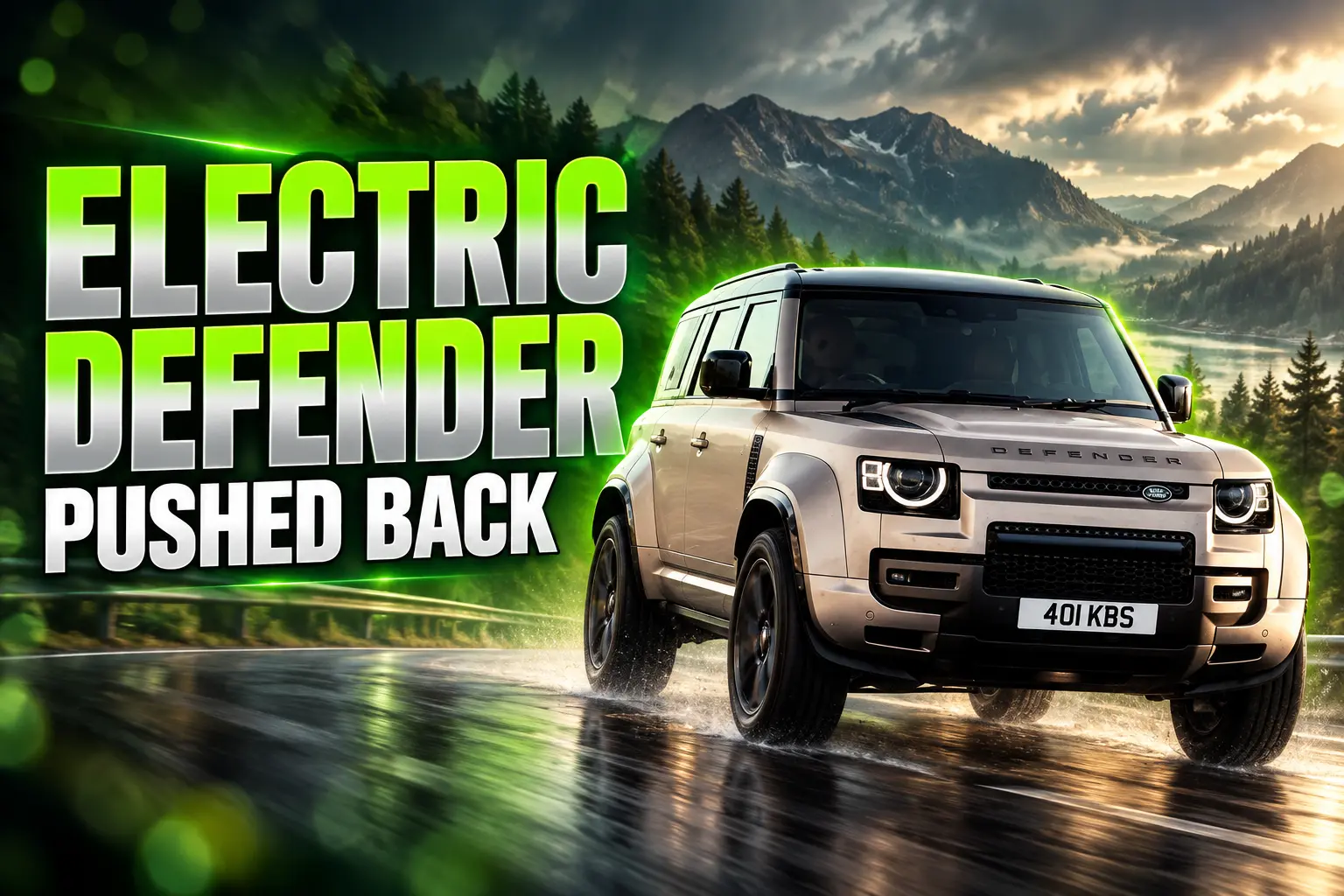
Why the Current Floor Pan Blocks a Battery
The 2020 Defender sits on D7x, a stiff aluminium off-road architecture drawn for engines and hybrids. A late-August report, drawing on company briefings, said that floor is too complex for a full battery pack and that the underbody lacks space for cells that would deliver adequate range.
That is why a battery 110 is tied to a new generation, not a running change. JLR has never put a firm public date on a Defender BEV, and it has not confirmed the early-2030s lock in its own name. The physical limit still explains the order of work: you cannot drop an 800-volt skateboard under a ladder that was never drawn for it.
A plug-in hybrid 110 already exists, which is the honest halfway house. It keeps the live off-road geometry and adds a lead of electric miles. It does not pretend the current tunnel can hide a 70 to 90 kWh pack without wrecking approach angles or wheel travel.
Mark Cameron, managing director for Defender and Discovery, has said every Defender still needs the brand’s “epic built-to-last, go-anywhere capability.” A skateboard floor helps city range. It fights the axle travel that makes a 110 feel like a 110 on rocks.
Range Rover Electric Jumps the Queue
On 17 June at Gaydon, chief executive P.B. Balaji set the launch order in public. Range Rover Electric and Range Rover Sport Electric stay on the Modular Longitudinal Architecture at Solihull and were due later in 2026. The first EMA car, built at Halewood, is also a Range Rover. A new Defender-family model is the second EMA vehicle, with hybrid as well as battery power “in the future.”
Despite the near-term industry challenges, we continue to see strong demand for our brands, and look forward to the launch of four sensational new products in the coming months: Range Rover Electric, Range Rover Sport Electric, Range Rover GT and Jaguar Type 01.
P.B. Balaji, Chief Executive Officer, JLR Q1 results, 13 August 2026
Journalists have already driven Range Rover Electric this week. The full-size Defender BEV is not on that list. JLR is not walking away from batteries; it is spending the next few launch windows on the luxury SUVs and the Jaguar GT, then on a smaller Defender, while the 90, 110 and 130 keep using the plant that already works.
WHO GETS A BATTERY FIRST
| Vehicle | Platform | Plant | Battery status |
|---|---|---|---|
| Defender 90, 110, 130 | D7x | Nitra | On sale; plug-in hybrid only |
| Range Rover Electric | MLA | Solihull | Due in the coming months |
| Range Rover Sport Electric | MLA | Solihull | Due in the coming months |
| Range Rover GT | EMA | Halewood | First EMA model, revealed |
| New compact Defender | EMA | Halewood | Second EMA; hybrid and BEV later |
| Next-gen full-size Defender | New architecture | Unconfirmed | Reported early 2030s |
Balaji’s June briefing also restated an £18bn five-year spend through FY29 and a £1.7bn cost cut aimed at bringing breakeven toward 300,000 units. In a year still digesting a cyber halt, that money goes to cars that can launch, not to a 110 that needs a new floor.
Halewood’s Next Defender Is a Smaller One
The delay of the next 110 is not a freeze on the Defender name. JLR has confirmed a new Defender-family model as the second EMA vehicle at Halewood, and the June plan added a full hybrid option to a platform that had been drawn as electric-first. That is greater propulsion flexibility across its brands, in the company’s own phrase, after global demand split by region.
The compact truck is widely expected in 2027 and is often called Defender Sport, though JLR has not locked the badge. Spy cars point to a length just over 4.5 metres, shorter than today’s 5.02-metre 110 and under the 4.58-metre 90 in spirit if not in door count. Cameron told interviewers in March that work was “well advanced” and that the small one still had to lead its class off road, even with a floor battery that will limit wheel travel against the current 110.
WHAT THE COMPACT EMA DEFENDER IS BUILT AROUND
- Plant: Halewood in Merseyside, the EMA shop, not Nitra.
- Power: Hybrid and battery versions, with hybrid no longer treated as an afterthought.
- Electrics: An 800-volt layout in full-electric form, with JLR talking about 350 kW charging.
- Role: A lower, more urban Defender that can take a skateboard floor, leaving the tall 110 on D7x until a new generation exists.
If that compact lands on time, the first battery Defender customers get will not get a 110. They will get a smaller, lower vehicle whose off-road brief is already being qualified against the floor pack. The full-size electric wait is the price of not faking a 110 on the wrong bones.
Nitra, Tariffs and a Stellantis Handshake
Nitra keeps building the three global Defenders. The United States is now the growth market Balaji wants to enlarge “to the size of the entire JLR business as it exists today,” and the finance bench has put US Defender volume around 30,000 a year, too thin, they say, to localise the current truck on its own.
On 20 May, JLR and Stellantis signed a non-binding deal to explore product development in the United States. Antonio Filosa, Stellantis chief executive, said the work would look for synergies in product and technology. Balaji said the tie-up supports long-term US growth. In June, JLR added that the Defender brand, not Range Rover, is the one it will point at that collaboration.
Q1 results already show US-UK car tariffs moving from 27.5% to 10%. A Slovakia-built 110 still crosses an import line. A future US-only Defender on Stellantis hardware would be a different product for a different tax bill, not a delayed electric 110 from Nitra. Treating those as the same car is how the delay story gets muddled.
THE YEAR THAT REORDERED THE QUEUE
- 1 September 2025: A cyber attack stops production for five weeks; output is back to normal only by mid-November.
- 20 May 2026: JLR and Stellantis sign the US product MOU.
- 17 June 2026: Gaydon puts Range Rover Electric first, adds hybrid to EMA, and names a new Defender as EMA’s second car.
- 30 June 2026: The quarter closes at 79,300 wholesales and a thinner profit.
- Late August 2026: The next full-size Defender is reported pushed from 2028 or 2029 into the early 2030s.
- 1 September 2026: Range Rover Electric is in journalists’ hands; the battery 110 is not.
The same 12 months included a supplier fire and Middle East disruption. Enterprise Missions are supposed to cut £1.7bn and drag breakeven toward 300,000 units. In that climate, a clean-sheet 110 with a new floor is a bill, not a lifeline.
JLR’s 2030 Battery List Still Names Defender
JLR’s own electrification page still lists 2026 for an all-electric Jaguar, 2030 for all nameplates to have a BEV variant, and 2039 for net zero across supply chain, products and operations. Thomas Müller, executive director of engineering, says that before the end of the decade Range Rover, Discovery and Defender will offer electrified options, with Jaguar entirely electric.
Defender already offers a plug-in hybrid, so “electrified options” can be ticked without a battery 110. A BEV on every nameplate by 2030 cannot, if the next-generation Defender only arrives in the early 2030s. The I-Pace left production in 2024. Until Range Rover Electric reaches showrooms, JLR still has no Land Rover battery car on sale.
WHAT WE KNOW
- Official order: Range Rover Electric and Range Rover Sport Electric launch first on MLA; the first EMA car is a Range Rover; a new Defender is second on EMA.
- Current 110: Stays on D7x at Nitra, with a plug-in hybrid and no confirmed full-electric conversion.
- Cash mix: Defender remains the volume name, and the three big SUVs now make more than four-fifths of wholesales.
WHAT IS UNCONFIRMED
- The 2030s date: Comes from a late-August report, not a JLR dated launch window.
- Compact timing and badge: 2027 and Defender Sport are widely used and unofficial.
- A US-built Defender: The Stellantis paper is non-binding; plant, platform and powertrain are not set.
Until a new architecture can hide a battery without killing the axle travel, Nitra will keep welding petrol 90s, 110s and 130s. The electric Defender that overlanders have been promised is the last car in a queue JLR redrew in June, and the first cars in that queue are already being driven.

Anker’s $94 MagSafe Dock Undercuts Apple on Prime Day

LG Will Sell the Apple-Designed Lock and Thermostat

Claude Asks to Keep Voice Recordings It Once Deleted

Jeep Bets One Grand Wagoneer Can Replace Two

Kortext Buys the Study Tool Already Inside Campus Software

Long Realty Drops Lundeen After the Flight 618 Arrest

Boox Picco Drops Phone Magnets for a Pocket Linux Reader

Land Rover Pushes the Electric Defender Into the 2030s

OPEC+ Holds October Oil Output After Six Paper Hikes

American Eagle Style Number on Tag – Decoding Clothing Label Information
-
 BUSINESS1 month ago
Long Realty Drops Lundeen After the Flight 618 Arrest
-
 NEWS1 month ago
Boox Picco Drops Phone Magnets for a Pocket Linux Reader
-
 BUSINESS1 month ago
OPEC+ Holds October Oil Output After Six Paper Hikes
-
 LIFESTYLE3 years ago
American Eagle Style Number on Tag – Decoding Clothing Label Information
-
LIFESTYLE3 years ago
How to Remove Sewn-In Tags – Techniques for Tag Removal from Clothing
-

 GAMING1 month ago
Kalshi Asks 11 Judges to Undo a Sports-Swap Split
-

 NEWS1 month ago
swXtch.io Lets a Chat Deploy Live Media Stacks
-

 NEWS1 month ago
ChatGPT Images 2.5 Splits Image Work Into Two Speeds