
NEWS
Samsung Raises Galaxy S26 Prices as Chip Profits Soar
Samsung’s US store lists the Galaxy S26 from $999.99 and the Ultra at $1,399.99, a mid-cycle hike that lands while its memory unit books record profit.

Samsung’s US online store lists the Galaxy S26 from $999.99 and the Galaxy S26 Ultra from $1,399.99 after a $100 rise on October 1. The 1TB Ultra is the outlier, up $200 to $1,999.99, and the Fan Edition is left at $699.99.
The change lands seven months after the March launch, in the same stretch that Samsung’s memory unit is on course for a record quarter. Phone shoppers are paying more for DRAM and NAND that Samsung also sells, at fat margins, into the AI buildout.
$999.99 Is the New Floor for the Galaxy S26
When the series went on sale in the United States on March 10, Samsung Electronics America posted pricing starting at $1,299.99 for the Ultra, $1,099.99 for the S26+, and $899.99 for the base S26. Those figures were already $100 above the prior S generation for the two cheaper phones. The October 1 list adds another $100 on almost every unlocked SKU.
Samsung.com now shows the Galaxy S26 from $999.99 on Samsung’s US store, or $41.67 a month for 24 months. The S26+ starts at $1,199.99. The Ultra’s 256GB model is $1,399.99, the 512GB is $1,599.99, and the 1TB is $1,999.99. Last year’s S25 still starts at $799.99 on the same page, so the new S26 sits $200 above its predecessor in a single generation.
More than 70% of worldwide pre-order customers picked the Ultra in March, Samsung said at launch, which means the phone that carried the series is the one that now clears $1,399.99. Instant trade-in credit is still advertised up to $720 on that model, and a $150 Samsung credit without a trade-in was listed through October 5.
THE US PRICE LIST AFTER OCTOBER 1
| Model | March launch | October 1 list | Change |
|---|---|---|---|
| Galaxy S26, 256GB | $899.99 | $999.99 | +$100 |
| Galaxy S26, 512GB | $1,099.99 | $1,199.99 | +$100 |
| Galaxy S26+, 256GB | $1,099.99 | $1,199.99 | +$100 |
| Galaxy S26+, 512GB | $1,299.99 | $1,399.99 | +$100 |
| Galaxy S26 Ultra, 256GB | $1,299.99 | $1,399.99 | +$100 |
| Galaxy S26 Ultra, 512GB | $1,499.99 | $1,599.99 | +$100 |
| Galaxy S26 Ultra, 1TB | $1,799.99 | $1,999.99 | +$200 |
| Galaxy S26 FE, 128GB | $699.99 | $699.99 | Unchanged |
The 1TB Ultra is the only US SKU that moved by $200, and it is the only one that ships with 16GB of RAM. The 256GB and 512GB Ultras stay at 12GB. Storage, not the camera bar, is where the second hike bites hardest.
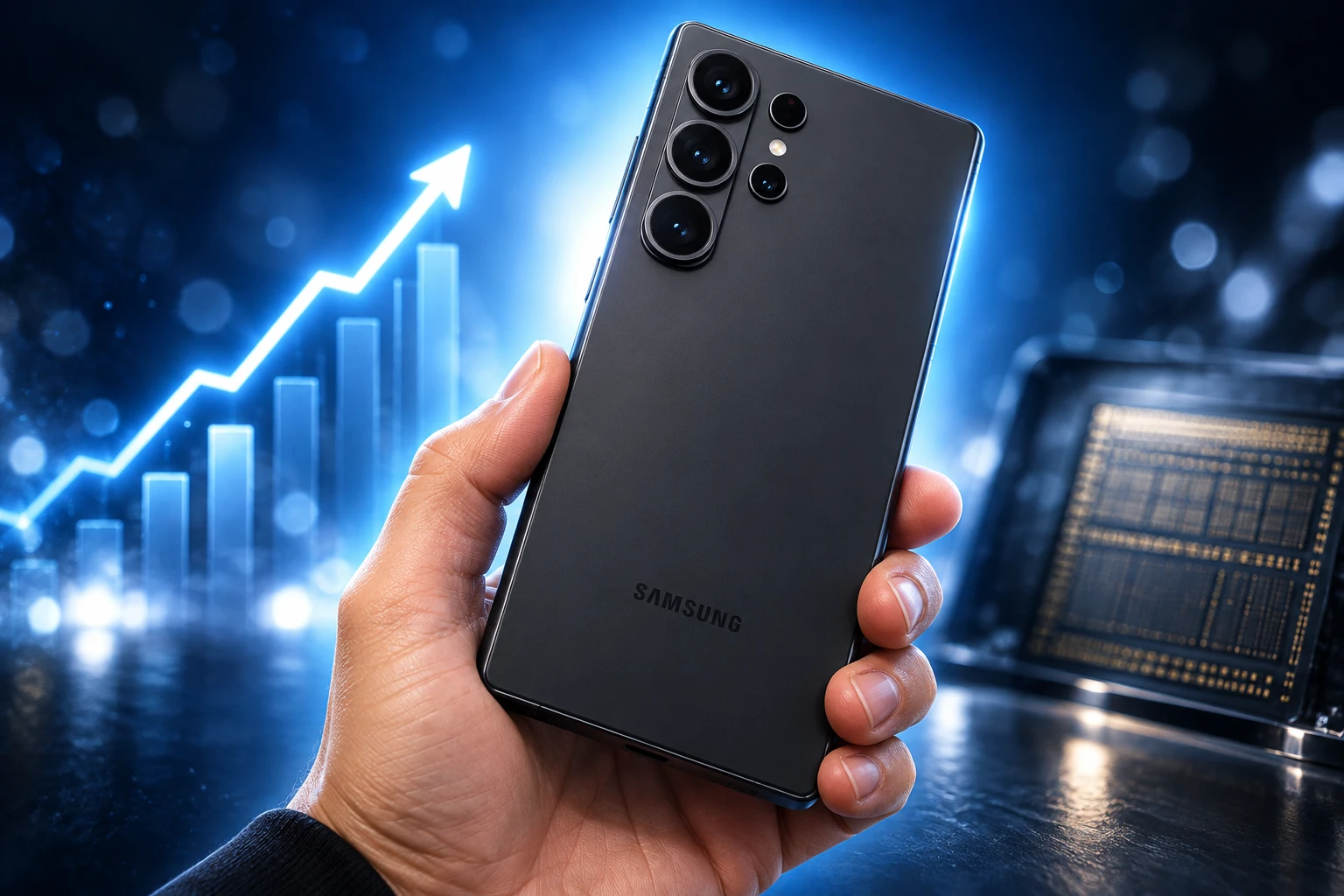
Samsung’s Chip Unit Is Booking Record Profit
The public reason is the same one Samsung used at launch: DRAM and NAND cost more. Phone memory prices jumped more than 80% quarter on quarter in the second quarter, Counterpoint Research found, and they have not come back. TrendForce put third-quarter contract DRAM up 13% to 18% on the prior quarter, with NAND up as much as 15%.
Samsung is not a bystander in that market. It is one of the three firms that still make the chips. FnGuide’s consensus as of October 1 put Samsung Electronics’ third-quarter operating profit at 110.3 trillion won ($81.1 billion), about 23% above the second quarter’s 89.5 trillion won, which would be the first quarter above 100 trillion won if the print holds. The second quarter was already up more than 1,800% on the year, and Samsung said its memory business had another record quarter, led by server parts.
Broker notes clustered around the same picture. Hana Securities put the memory unit’s third-quarter operating margin at 80%, with DRAM at 83% and NAND at 72%. Other desks had the unit in a 70% to 80% band. That is the other side of the $100 on the box.
SAMSUNG’S MEMORY YEAR IN FOUR FIGURES
- Second-quarter profit: 89.5 trillion won, up more than 1,800% from a year earlier, with memory the driver.
- Third-quarter consensus: 110.3 trillion won, about 23% above the prior quarter and the first print above 100 trillion won if met.
- Memory margins: desks see 70% to 80% for the unit, with DRAM near 83% on Hana’s numbers.
- How long it lasts: Samsung said in July the shortage could run through 2028, and it is locking 60% to 70% of medium-term memory output under long-term deals.
Micron, the US name in that three-firm club, posted fiscal fourth-quarter revenue of $54.23 billion, nearly five times the $11.32 billion a year earlier. More than 75% of its fiscal 2027 output is already spoken for.
Memory and storage supply-demand conditions would be much tighter in fiscal 2027 and 2028 than in 2026.
Sanjay Mehrotra, chief executive, Micron Technology, earnings remarks
A live memory chip price tracker still shows the same squeeze in the spot tape, from HBM stacks down through DDR5 and phone LPDDR. The parts inside a Galaxy S26 are not a side market. They are the leftover of a market that has been bid up by data centers.
HBM Takes the Wafers Phone Memory Needs
High-bandwidth memory is the reason the leftover is so thin. HBM is the stacked DRAM that sits next to AI accelerators, and it burns far more wafer area per bit than the LPDDR in a phone. Kim Taewoo, a Samsung Electronics executive vice president, said in late September that HBM is expected to take nearly 30% of the industry’s DRAM wafer capacity next year, up from about 20%, and that HBM and standard DRAM compete for the same wafers.
KB Securities has Samsung’s own mix moving the same way: HBM at 27% of its DRAM capacity last year, 33% this year, and 40% in 2027, with conventional DRAM falling from 73% toward 59%. Lead times for high-capacity server DDR5 have stretched to 52 weeks. Every extra HBM stack is a decision not to ship another reel of phone DRAM.
Samsung had signed long-term supply deals with five big data-center customers by July and was close on five more, a book that would cover roughly 60% to 70% of its medium- to long-term memory capacity. SK hynix ran a similar five-year round with about 10 clients. The AI buyers got the contracts. Mobile, PC, and vanilla server DRAM got the shortage, and then the price list.
CFO Park Soon-cheol told an earnings call the global memory shortage is expected to deepen in 2027 and stay tight through 2028. That is the planning horizon behind a mid-cycle phone hike. If the wafer plan holds, there is no cheap NAND sitting around for a Black Friday reset of the 1TB Ultra.
Does the Galaxy S26 Ultra Cost More Than the iPhone 18 Pro Max?
Yes. The 256GB Galaxy S26 Ultra lists at $1,399.99 in the US, and Apple’s iPhone 18 Pro Max starts at $1,299 for 256GB. Apple raised that flagship by $100 at its September 9 event, a smaller pass-through than some desks had modeled, and it pushed the extra onto the bigger storage rungs instead.
TechInsights’ tracker puts memory now more than 30% of the bill of materials on a premium phone. An LPDDR5 96Gb package that was about $140 in June was about $165 by the iPhone 18 launch, and a 256GB TLC UFS part went from about $68 to about $82. Those are Apple’s inputs. Samsung sells the same class of parts as a vendor, then pays them as a phone maker, then prints a new MSRP.
FLAGSHIP 256GB AND 512GB, US LIST
| Phone | 256GB | 512GB |
|---|---|---|
| Galaxy S26 Ultra | $1,399.99 | $1,599.99 |
| iPhone 18 Pro Max | $1,299 | $1,499 |
| iPhone 18 Pro | $1,199 | $1,399 |
| Galaxy S26+ | $1,199.99 | $1,399.99 |
The 1TB Ultra at $1,999.99 now sits $100.99 above Apple’s 1TB Pro Max at $1,899. Apple also added a 2TB rung the Galaxy line does not have. Carrier credits still blur both tickets, and Apple is advertising up to $1,200 off with an iPhone 14 or newer trade-in. On unlocked list price, the Ultra is the dearer 256GB slab.
Korea, India, and Europe Already Moved
The US store was late, not unique. Samsung raised Korean list prices on October 1, the same day the US tags flipped, about seven months after the March launch there. India had already moved in September. Checks of Samsung.com in Canada, the UK, and mainland Europe showed higher figures as well.
WHAT CHANGED OUTSIDE THE US STORE
- South Korea, October 1: the 256GB S26, S26+, and Ultra each rose 149,600 won, taking the base S26 from 1,254,000 won to 1,403,600 won, with the 1TB Ultra up 276,100 won to 2,821,500 won.
- India, September 23: most variants rose Rs 15,000, so the 256GB S26 went from Rs 87,999 to Rs 102,999, a 17% lift, and the 1TB Ultra rose Rs 25,000 to Rs 214,999.
- UK and Europe: Samsung’s own regional stores showed the Ultra 256GB at £1,360 and €1,550 after the change, about £80 and €100 above the prior local lists.
- Canada: the Ultra 256GB moved to C$2,050 on the Canadian store after a C$150 lift.
A Naver-based leaker, Lanzuk, said Samsung had already drafted S27 starting prices and was preparing another lift in the high-130,000-won range, about $100, because DRAM and NAND have kept climbing. Samsung has not confirmed any S27 list. The useful part of that leak is the baseline it assumes: next year’s brochure starts from this year’s new floor, not from the March tags.
Amazon, Micro Center, and the $699.99 Fan Edition
Samsung’s own site is not the whole market. When the US list moved on October 1, other tills had not all followed. Micro Center still showed the unlocked 256GB Ultra at $1,299.99, the old launch price. Amazon had not matched Samsung.com’s new tags when those went live, which left a short window to buy the March MSRP on a different checkout.
The Fan Edition never entered this round. The Galaxy S26 FE still starts at $699.99 for 128GB and $799 for 256GB, the prices it carried when it went on sale on September 4. That is $300 below the new base S26. It is also $50 above last year’s FE, so the cheaper phone already took a smaller hit, then got left alone.
Certified Re-Newed S26 Ultra units on Samsung.com start at $1,269.00, which undercuts the new 256GB list. Last year’s S25 Ultra still starts at $1,299.99, the number the new Ultra just vacated.
THE TICKETS THAT DID NOT JOIN THE HIKE
- Galaxy S26 FE: $699.99 for 128GB, $799 for 256GB, still the March-era FE list.
- Micro Center 256GB Ultra: $1,299.99 at the old unlocked launch price when Samsung.com had already moved.
- Certified Re-Newed Ultra: from $1,269.00 on Samsung’s own refurbished shelf.
- Galaxy S25 Ultra: still from $1,299.99, $100 below the new S26 Ultra 256GB.
A full $720 trade-in on a new Ultra would put the cash outlay near $679.99, in FE territory, if the quote actually clears that cap. That is the only way the $1,399.99 Ultra still looks like March money. Without a trade, the unlocked gap is the list.
Holiday Shoppers Face a Higher Starting Tag
Flagship seasons usually run the other way by October. List prices ease, carriers stack credits, and the 512GB SKU that looked dear in March becomes the Black Friday default. This cycle opened with a $100 launch premium, then added another $100 on the maker’s own store before the holiday ads are even cut.
Any “$100 off” tile that appears against the new $999.99 S26 is a return to the March tag, not a cut below it. The 1TB Ultra has to fall $200 just to recapture its launch price of $1,799.99. Samsung still has the $720 trade-in lever, and carriers can bury list prices inside bill credits, but the reference number on samsung.com is the one that moved.
The wafer math does not point to a quiet December. HBM is booked years out, conventional DRAM is on 52-week leads, and Samsung’s own guidance runs through 2028. The company that stamps the memory inside the S26 is the company that just restickered it, and the resticker is the cheaper way to keep phone margins while the chip unit prints the quarter.

Anker’s $94 MagSafe Dock Undercuts Apple on Prime Day

LG Will Sell the Apple-Designed Lock and Thermostat

Claude Asks to Keep Voice Recordings It Once Deleted

Jeep Bets One Grand Wagoneer Can Replace Two

Kortext Buys the Study Tool Already Inside Campus Software
How to Remove Sewn-In Tags – Techniques for Tag Removal from Clothing

Long Realty Drops Lundeen After the Flight 618 Arrest

Land Rover Pushes the Electric Defender Into the 2030s

Boox Picco Drops Phone Magnets for a Pocket Linux Reader

OPEC+ Holds October Oil Output After Six Paper Hikes
-
LIFESTYLE3 years ago
How to Remove Sewn-In Tags – Techniques for Tag Removal from Clothing
-
 BUSINESS2 months ago
Long Realty Drops Lundeen After the Flight 618 Arrest
-
 AUTO2 months ago
Land Rover Pushes the Electric Defender Into the 2030s
-
 NEWS2 months ago
Boox Picco Drops Phone Magnets for a Pocket Linux Reader
-
 BUSINESS2 months ago
OPEC+ Holds October Oil Output After Six Paper Hikes
-

 LIFESTYLE3 years ago
American Eagle Style Number on Tag – Decoding Clothing Label Information
-

 GAMING1 month ago
Kalshi Asks 11 Judges to Undo a Sports-Swap Split
-

 NEWS2 months ago
swXtch.io Lets a Chat Deploy Live Media Stacks