
NEWS
Googlebook Pre-Orders Open as Five PC Makers Carry the Launch
Google set a September 21 pre-order for Googlebook laptops, but Acer, ASUS, Dell, HP and Lenovo still hold the machines, prices and ship dates.

Google will take Googlebook pre-orders on September 21 at 9 a.m. ET, with no public price, no model list and no ship date. The first wave is assigned to Acer, ASUS, Dell, HP and Lenovo, the five PC makers named on Google’s own site. Google owns the brand, Gemini and the calendar; those five firms have to build, price and stock the machines.
An email to people who asked for updates, using the line “Get ready for Googlebook,” is what locked the hour. The pre-orders starting on September 21 line is now on the product site, six days after an embargoed media preview in New York on September 15. A notify button is live. A buy button is not.
Five Laptop Makers Carry the Risk Google Dropped
Google is not shipping a Pixel-branded clamshell this time. The FAQ on the product site is blunt about who cuts the metal: the first Googlebooks launching in the fall will be made by Acer, Asus, Dell, HP and Lenovo. Samsung, which builds more Android phones than any of them, is not on that list.
That split is how Google gets a premium laptop line without standing up the hardware group it shut down in 2022. It is also how a pre-order date can go live before anyone knows which lid you can actually pay for. Google has not said which partner machines go on sale on September 21, and it has not said when a paid order turns into a box on a desk.
The company posted a short teaser, now on the Android YouTube channel under the title “Googlebook Pre-Order Coming Soon,” that spends its time on the lid light bar rather than on a spec sheet or a dollar figure.
The five names are not leaving Windows. They are adding a Google-branded SKU next to the notebooks they already sell, which is a cheaper bet for them than it was for Google when it still built Pixelbook itself.
Lenovo, Acer and ASUS Already Put Machines on Paper
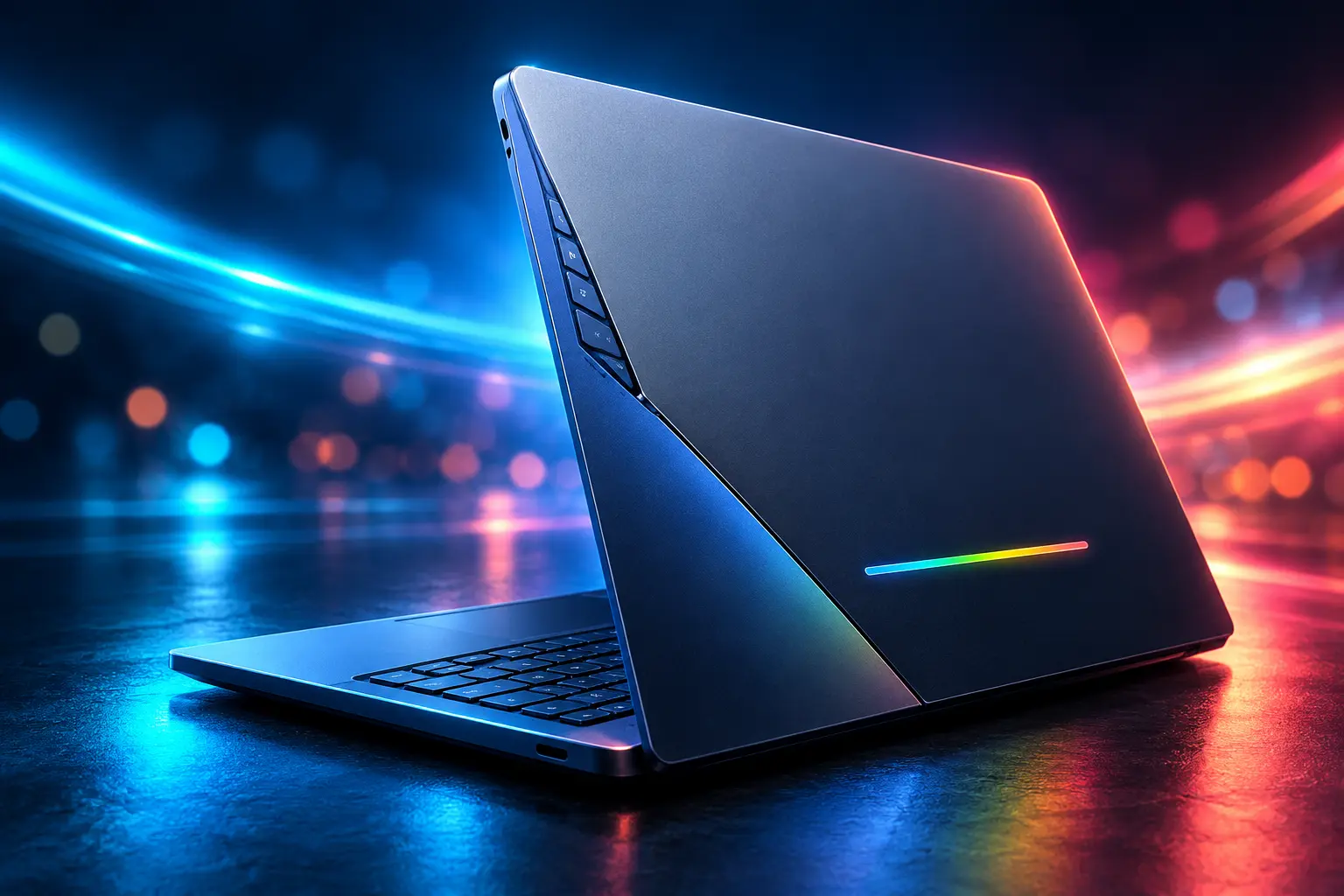
Partner hardware has been leaking for weeks while Google’s public page still talks in slogans. Lenovo is the loudest. A spec sheet circulating for the Lenovo Googlebook 15, listed as GB 15IPH12, describes a 15.3-inch OLED touchscreen at 2,880 x 1,800, 120Hz, 500 nits and 100% DCI-P3, over an Intel Core Ultra 5 325 with four performance cores and four efficiency cores. Memory is 16GB or 32GB of LPDDR5X. Storage is 256GB or 512GB. The chassis is listed at 1.29 kg and 15.9 mm, with a 70Wh battery that Lenovo’s own test notes put at up to 11 hours, two Thunderbolt 4 ports, USB-A, HDMI 2.0, a haptic glass trackpad, a fingerprint reader and a “Google facial authentication” array, plus the lid glowbar.
Lenovo has also shown a detachable, talked about as Googlebook Duet m, and a smaller clamshell that has stayed blurrier. Acer and ASUS have been easier to find in retailer back ends than Dell or HP, and both of those 14-inch Intel machines use the same Core Ultra 5 325 as the Lenovo 15.
THE FIRST-WAVE HARDWARE THAT HAS SURFACED
| Maker | Machine in filings or leaks | Chip | Display called out |
|---|---|---|---|
| Lenovo | Googlebook 15 (GB 15IPH12) | Core Ultra 5 325 | 15.3-inch 120Hz OLED |
| Acer | Googlebook 14 | Core Ultra 5 325 | 14-inch 2.8K 120Hz OLED |
| ASUS | CX9406 | Core Ultra 5 325, Ultra 7 variants | 14-inch touchscreen |
| HP | Googlebook 14c | Snapdragon X Elite X1E-80-100 | 14-inch touchscreen in the filing |
| Dell | XPS 13 (DX13267) | Snapdragon-class ARM | 13-inch class chassis |
HP’s trail is a filing, not a glamour shot. An Energy Star database entry for HP Googlebook 14c-cf lists Qualcomm’s 12-core Snapdragon X Elite X1E-80-100, 32GB of memory and an operating system entered as Android, with a 45 TOPS Hexagon NPU attached to that chip in the surrounding spec trail. Dell has been quieter still. A Geekbench run under Dell XPS 13 (DX13267) pointed at an Android 17 desktop build, sitting next to Dell’s Windows XPS 13 numbering. Acer, for its part, already confirmed a Googlebook in public around IFA, ahead of Google’s own New York room.
The silicon split is the partners hedging, not Google picking a single CPU story. Three of the leaked Intel machines share Panther Lake. HP, and likely Dell, are on Snapdragon. If Lenovo’s quieter 14-inch board is the Snapdragon unit trackers have been following, one company would be selling both kinds of Googlebook on day one.
Gemini Starts at the Cursor
Google is selling a software idea more than a single chassis. On May 12 it called Googlebook the first laptops designed for Gemini Intelligence, built with DeepMind on a cursor that had barely moved since right-click. The retail OS name is still missing. Aluminium has been the development codename, and Google has already said that name will not ship on the box.
Just wiggle your cursor and watch it come alive with Gemini, offering quick, contextual suggestions every time you point at something on your screen.
Google, Introducing Googlebook, May 12, 2026
The demo Google keeps repeating is small on purpose. Point at a date in an email and set a meeting. Select a photo of a room and a photo of a couch and see them together. Create My Widget, on the same page, is the other half of that pitch: ask for a dashboard and let Gemini pull Gmail, Calendar or the web into a custom tile. Whether that feels like a laptop or like a chatbot taped to a trackpad is the part no embargoed preview has yet had to answer in public.
WHAT GOOGLE SAYS A GOOGLEBOOK DOES
- Magic Pointer: Wiggle the cursor, point at something on screen, and Gemini offers a next step.
- Create My Widget: Describe a widget and let Gemini build it from your Google apps or the web.
- Cast My Apps: Open phone apps on the laptop without installing them, with setup required.
- Quick Access: Open files from the phone as if they already live on the laptop.
- The lid bar: A multicolor glowbar on every Googlebook, borrowed from an older Google laptop.
The site’s own FAQ draws a hard line under Chromebook. Googlebooks are “a brand-new category of flagship laptops bringing together the best of ChromeOS and Android,” with higher-grade materials and phone hooks. Chromebooks “run ChromeOS and are built to prioritize simplicity, speed and efficiency.” Cast My Apps and Quick Access need a phone on Android 17 or newer. That requirement quietly turns the laptop into an accessory for people already in Google’s phone software, which is the whole point of asking HP and Dell to tool up for a third OS.
Leaked Lenovo decks go further than Google has, putting a G key where a Windows key usually sits and floating desktop-class apps such as Premiere. Adobe has put Premiere on Android in a limited early-access run. That is not the same thing as a 15-inch timeline editor that feels like a PC, and it is the test that will decide whether these machines are expensive Chromebooks with a better hinge.
The Glowbar Last Showed Up on a Laptop Google Killed
The light strip is not new. It is the one design Google is willing to drag across a decade of abandoned notebooks. Chromebook Pixel shipped on February 21, 2013 with a four-segment lid bar in Google’s colors, a $premium proof of concept Sundar Pichai’s team framed as a way to push the high end. Pixelbook followed on October 4, 2017 at about $1,000, with configurations that ran to $1,699, and Pixelbook Go arrived on October 15, 2019 as the thinner, cheaper sequel. In September 2022 Google dissolved the Pixelbook team and canceled a follow-up that was already far along, after Rick Osterloh, then the hardware chief, had still been talking about future Pixelbooks. Cost cuts under Pichai were the public reason. Chromebooks from other brands had also closed the gap, which made a $1,000 Google laptop harder to defend.
Introducing Googlebook, the first laptop designed for Gemini Intelligence. It’s crafted for heavyweight performance, built with Gemini at the core and perfectly synced with your Android phone. Coming this fall. 💻✨#TheAndroidShow pic.twitter.com/rn4pztApmp
— Google (@Google) May 12, 2026
On May 12, 2026, Google tried the category again, this time on someone else’s factory line. The announcement post called Googlebook “the first laptop designed for Gemini Intelligence,” coming in the fall, and the replies immediately treated the name as a punchline. The name does sound like a product Google already buried, and like a joke it did not mean to tell. Keeping the glowbar is how you signal that this is that line again. Handing the chassis to Lenovo and HP is how you avoid staffing another team you might have to kill.
GOOGLE’S LAPTOP DATES
- February 21, 2013: Chromebook Pixel ships with the colored lid light bar.
- October 4, 2017: Pixelbook is announced at about $1,000.
- October 15, 2019: Pixelbook Go ships as the last Google-made sequel.
- September 2022: Google dissolves the Pixelbook team and cancels the next model.
- May 12, 2026: Googlebook is unveiled at The Android Show, with five OEM partners.
- September 15, 2026: Invited media see hardware in New York under embargo.
- September 21, 2026: Pre-orders open at 9 a.m. ET.
Education and enterprise Chromebooks are not being pulled. Google has kept that simpler line on a separate track, which is another way of saying Googlebook is not a rename. It is a second bet on a smaller, richer slice of the same market.
Retailer Listings Already Printed Four-Figure Prices
Google still will not say what a Googlebook costs. Other people’s databases will. A Canadian retailer listing put an ASUS Googlebook with Core Ultra 5 325, 16GB of RAM and a 512GB drive at CA$1,900 ($1,365), and other ASUS configs in the same leak trail run up to 32GB or 64GB with a Core Ultra 7. A European listing put an Acer Googlebook 14 with the same Core Ultra 5 325, 16GB of LPDDR5X, a 256GB drive and a 14-inch 2.8K 120Hz OLED at €1,022 ($1,178). Those are not Google’s numbers, and they are not a full price list. They are enough to show the band these machines are walking into.
That band is Pixelbook money, not Chromebook money. A 14-inch OLED notebook at $1,178 is already past the school-board machines that made ChromeOS famous, and the ASUS listing sits higher still once you add RAM. Google’s last in-house premium laptop had the same problem: it was good, and it cost as much as a Windows ultrabook that could run the software people already had. If Magic Pointer is the reason to pay that again, the demo has to survive a Tuesday afternoon of real documents, not a staged email with a date in it.
The glowbar will not close that gap on its own. On phones, Google has already used a similar light as decoration. Unless the lid strip does work a buyer can name, it is a 2013 party trick glued to a 2026 BOM, and the BOM is what Acer and ASUS are about to print on a checkout page.
New York Sees the Hardware Under Embargo
September 15 is not the public launch. Google told press the New York session is an embargoed event and that nothing would be announced that day. Invited reporters were due to hear a keynote on the software, then put hands on partner machines, which is why the pre-order email, landing a day earlier, felt like the company dating the checkout page before it dated the spec dump.
WHAT WE KNOW
- The checkout hour: Pre-orders open September 21 at 9 a.m. ET, per Google’s own email.
- The five makers: Acer, ASUS, Dell, HP and Lenovo are the named first wave.
- The software pitch: Magic Pointer, Create My Widget, Cast My Apps and Quick Access, with Android 17 required on the phone.
- The fall unbox line: Google still only promises that the first machines can be unboxed in the fall.
WHAT IS UNCONFIRMED
- Which SKUs go live: Google has not said which partner laptops can be ordered on September 21.
- The price: No official figure, only retailer listings for Acer and ASUS configs.
- The ship date: A pre-order is not a delivery calendar.
- The OS name: Aluminium remains a codename Google has said it will replace.
The pre-order button can still go live at 9 a.m. ET on September 21 with a price missing and a model list missing, because the people who have to fill those fields sit in Taipei, Beijing, Round Rock and Palo Alto, not only in Mountain View. That is the deal Google made when it stopped making the laptop itself.

Anker’s $94 MagSafe Dock Undercuts Apple on Prime Day

LG Will Sell the Apple-Designed Lock and Thermostat

Claude Asks to Keep Voice Recordings It Once Deleted

Jeep Bets One Grand Wagoneer Can Replace Two

Kortext Buys the Study Tool Already Inside Campus Software
How to Remove Sewn-In Tags – Techniques for Tag Removal from Clothing

Long Realty Drops Lundeen After the Flight 618 Arrest

Land Rover Pushes the Electric Defender Into the 2030s

Boox Picco Drops Phone Magnets for a Pocket Linux Reader

OPEC+ Holds October Oil Output After Six Paper Hikes
-
LIFESTYLE3 years ago
How to Remove Sewn-In Tags – Techniques for Tag Removal from Clothing
-
 BUSINESS2 months ago
Long Realty Drops Lundeen After the Flight 618 Arrest
-
 AUTO2 months ago
Land Rover Pushes the Electric Defender Into the 2030s
-
 NEWS2 months ago
Boox Picco Drops Phone Magnets for a Pocket Linux Reader
-
 BUSINESS2 months ago
OPEC+ Holds October Oil Output After Six Paper Hikes
-

 LIFESTYLE3 years ago
American Eagle Style Number on Tag – Decoding Clothing Label Information
-

 GAMING1 month ago
Kalshi Asks 11 Judges to Undo a Sports-Swap Split
-
 NEWS1 month ago
swXtch.io Lets a Chat Deploy Live Media Stacks