
NEWS
Open Cosmos Takes €300 Million From Security-Minded Backers
Open Cosmos closed €300 million with NSSIF, ICF and pension funds on the cap table, buying factory capacity Europe can use before IRIS2 launches in 2029.

Open Cosmos has secured €300 million in funding ($348 million) to expand satellite factories that already serve European governments. The round closed on 14 September 2026 and was led by Lightrock, with the UK’s National Security Strategic Investment Fund, Catalonia’s public bank and a Canadian pension fund on the list.
The company did not publish a valuation. People close to the deal put it at about $2 billion. That is a large cheque for a hardware firm that still employs close to 400 people. The quieter fact is who wrote parts of it, and which states are already waiting for the metal.
NSSIF and Catalonia’s Bank Join the Cap Table
Ashish Puri, a partner at Lightrock, said the firm is “delighted to be leading Open Cosmos’ funding round.” The company itself described the raise as led by European investors. Both can be true: a London growth fund ran the process, and a cluster of public and long-horizon names sat in the syndicate.
The National Security Strategic Investment Fund is the UK government’s corporate venturing arm for dual-use technologies, set up with the British Business Bank. Space, flight and future telecommunications are a stated focus. It invests commercially, beside private funds, in firms whose kit can serve both civilian buyers and the national security community. Institut Català de Finances is Catalonia’s public finance institute. British Columbia Investment Management Corporation is one of the two international pension funds in the round.
WHO PUT MONEY IN
| Backer | What it is | Role in this round |
|---|---|---|
| Lightrock | Private growth fund | Lead |
| NSSIF | UK government dual-use CVC | Participant |
| ICF | Catalan public finance | Participant |
| BCI | Canadian pension capital | One of two pension funds |
| ETF Partners | Growth investor, prior lead | Returned from the 2023 round |
Entrepreneurs First, Convex Group, Phoenix Court (the home of LocalGlobe and Latitude) and Claret Capital Partners also took part. Claret was already on the register from the last raise. This is not a defence ministry writing a single cheque. It is state-adjacent capital riding a private round because the customers on the shop floor are governments that want their own birds.
The Governments Already on the Order Book
Open Cosmos says it has signed more than $370 million in customer contracts over the past three and a half years, and that it has delivered five consecutive years of profitable growth. Founder and chief executive Rafel Jorda Siquier said the new money is there to satisfy “the satellite manufacturing orders that governments and large companies are placing.”
Those orders are not a mood. Greece hired the firm to build a national microsatellite set and to open a plant near Athens. Spain picked it to build that country’s share of the Atlantic Constellation with Portugal, with a UK pathfinder satellite in the same plane. The company’s own shared system, OpenConstellation, is the wrapper that lets those national fleets share capacity instead of each state paying for a full stack.
PROGRAMMES ALREADY TIED TO THE PLANTS
- Greece: Seven microsatellites under the national programme, plus a ground station, built at Open Cosmos Aegean in Pallini.
- Spain and Portugal: Atlantic Constellation optical and radio payloads, with a UK pathfinder on the first plane.
- United Kingdom: Approved supplier on Lot 2 of the TacSys tactical communications framework, running to June 2034.
- OpenConstellation 1.0: Shared Earth-observation birds due for launch through 2026, built in the UK, Spain, Greece and Portugal.
Space Minister Baroness Lloyd called the round “a major vote of confidence in Open Cosmos and Britain’s growing space sector,” and pointed to previous UK government support. Patrick Sheehan, managing partner at ETF Partners, said the conditions for building large space companies have “now converged in Europe.” Saul Klein, co-founder and chair of Phoenix Court, called it a profitable space company that can manufacture satellites at scale.
Four Factories and a One-a-Day Claim
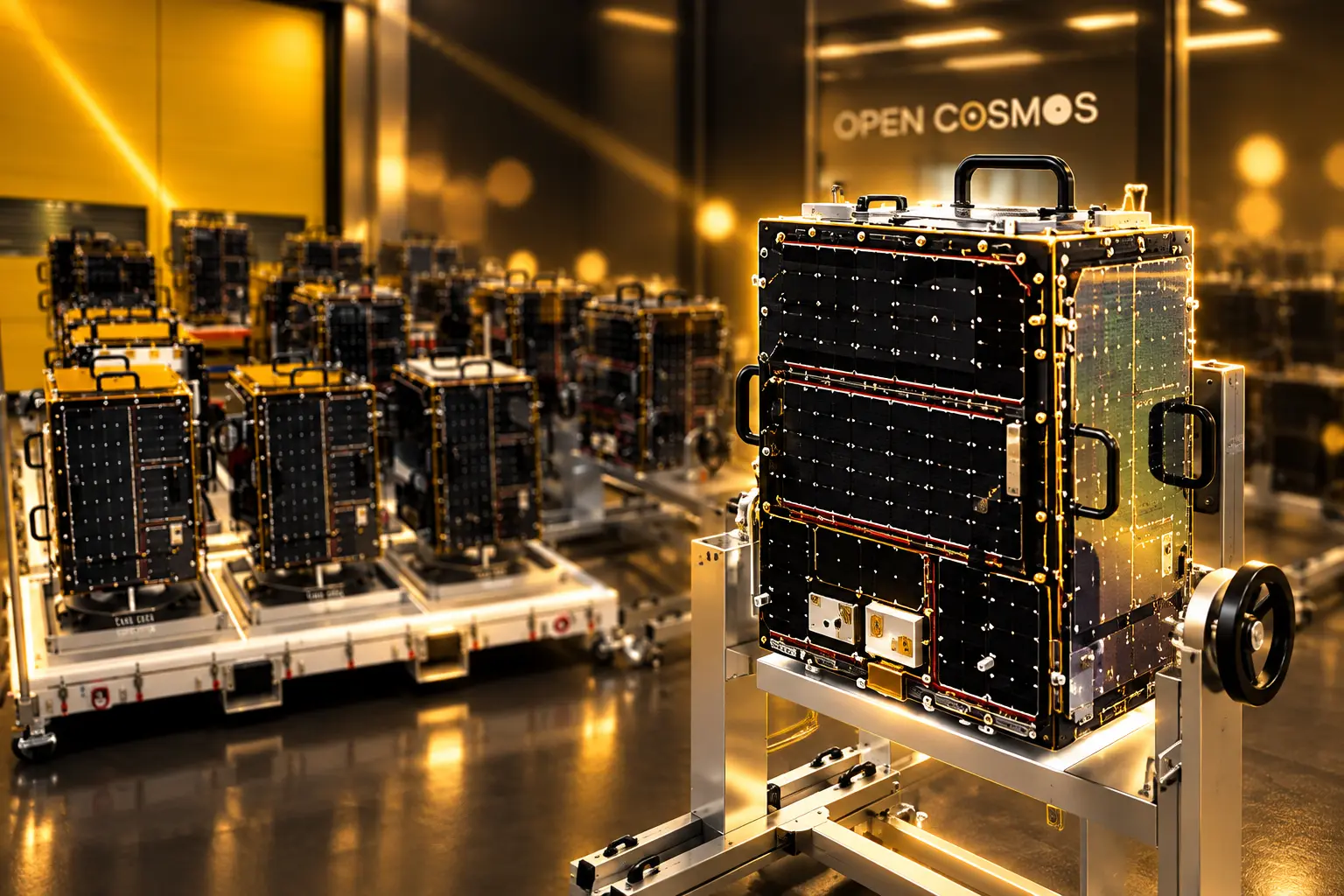
Open Cosmos was founded in 2015 and is based at Harwell in Oxfordshire, with operations in Barcelona, Portugal and Greece. It now runs four European factories and says those plants have the combined capacity to manufacture one satellite a day. That is a statement about capacity, not about how many spacecraft actually roll out of the door each morning.
THE INDUSTRIAL SNAPSHOT
- Headcount: Close to 400 people in the UK, Spain, Portugal and Greece, with hiring planned in engineering, manufacturing and software.
- Cadence claim: Combined factory capacity of one satellite a day, up from a Harwell line that was averaging one every three days earlier in 2026.
- Backlog: More than $370 million of contracts signed in three and a half years, against five years of profitable growth.
- Capital stack: More than $390 million raised to date, including this round, after a $50 million Series B in September 2023.
The €300 million is about seven times that Series B in dollar terms. The company will use it to expand ConnectedCosmos, grow OpenConstellation and DataCosmos, and raise manufacturing capacity. In other words, more of the same stack: build the satellite, fly it, sell the link, sell the picture.
Why the Money Arrived Before IRIS²
Europe already has a flagship answer to US broadband constellations. IRIS² is the EU’s third satellite flagship after Galileo and Copernicus. The programme is now costed at about €15.6 billion for 348 satellites, with first launches slated for 2029 and government service in 2030. Airbus and Thales Alenia Space have started work on a first low-orbit layer of at least 66 satellites for Eutelsat, due in 2029.
That is a long wait if you run a ministry that wants pictures this winter, or a link that does not sit on a US operator. Open Cosmos is selling the gap: national fleets and a shared constellation that can be built in European plants now, while IRIS² is still in design.
TWO CLOCKS ON EUROPEAN ORBIT
| Measure | Open Cosmos, 2026 | IRIS² plan |
|---|---|---|
| First new hardware | ConnectedCosmos already flying; OpenConstellation 1.0 launching through 2026 | First launches 2029 |
| Scale on paper | Four-factory, one-a-day capacity | 348 satellites (330 low orbit, 18 medium) |
| Money attached | €300 million private round plus $370 million+ of signed contracts | About €15.6 billion programme cost |
| Who holds the stack | A company selling to states and firms | EU concession via the SpaceRISE group |
PitchBook’s space-tech tally shows why a factory story can raise this much. Venture-backed space companies raised $11.3 billion across 244 deals in the first half of 2026, more than the $10.1 billion invested across 433 deals in all of 2025. The median round more than doubled to $14.5 million from $7 million, and late-stage and venture-growth deals took 87.4% of the cash. Satellites alone drew $2.8 billion in the half. The Exploration Company, a European re-entry and capsule firm, closed $450 million days earlier. Bigger cheques are going to plants, not to slide decks.
ConnectedCosmos Tries to Skip the Cable
The product the security money is underwriting is a closed loop. OpenOrbit designs and flies the spacecraft. OpenConstellation lets states share them. ConnectedCosmos carries broadband and IoT traffic between satellites and the ground. DataCosmos turns the imagery into something a duty officer can use. On 30 June 2026 the company said OpenConstellation 1.0 would deliver actionable intelligence in as little as 30 minutes, against up to 48 hours for older Earth-observation chains, and capture up to 3 million square kilometres of data a day.
By bringing together satellites, secure communications and AI-powered data services, we’re creating a system that transforms information from orbit into something that governments and enterprises can act on. This investment allows us to accelerate that vision, satisfying the satellite manufacturing orders that governments and large companies are placing for our reliable and high-performance satellites and delivering the sovereign services the world needs.
Rafel Jorda Siquier, founder and CEO, Open Cosmos announcement, 14 September 2026
The working example in the company’s own note is a fire. A satellite sees a heat spike, onboard software flags it, ConnectedCosmos relays the alert to crews even if the terrestrial net is down, and extra birds plus ground sensors are tasked to check the scene. That is the pitch to ministries that spent the last two years arguing about dependence on a single US constellation.
Within two months of winning access to Liechtenstein’s Ka-band filings, Open Cosmos had launched its first ConnectedCosmos satellites. The filings beat rivals backed by Peter Thiel and by Chinese investors. The first two spacecraft were built at Harwell. Optical inter-satellite links are meant to move data bird-to-bird without touching the ground, so a client can stay off subsea cables and off the public internet if it wants to.
€300 million to scale the next generation of space infrastructure.
Over the past decade, Open Cosmos has grown into one of Europe’s leading satellite manufacturers. Today, we are capable of manufacturing one satellite a day across our four European factories and have signed… pic.twitter.com/4jYJ5lnVr6
— Open Cosmos (@Open_Cosmos) September 14, 2026
A Framework Worth Up to £8 Billion
Twelve days before the equity round, Open Cosmos said the Government Commercial Agency had certified it as a supplier on TacSys, the Ministry of Defence tactical communications framework, estimated at up to £8 billion and mapped to future MoD contracts until June 2034. ConnectedCosmos is the payload: a low-orbit layer the company says lines up with the MoD’s £7.5 billion Digital Backbone and Targeting Web work.
That £8 billion figure is a ceiling on a multi-supplier framework, not cash in Open Cosmos’s bank. The firm was named on Lot 2 (Systems). Being an approved vendor means it can bid when the MoD buys; it does not mean the ministry has placed an £8 billion order. The contracted number that is already real remains the $370 million+ signed over three and a half years. Anyone treating TacSys as a booked revenue line is reading a catalogue as a receipt.
Jorda said the British government “recognises the need for a modern, sovereign-controlled satellite network over the UK,” and that the firm wants to meet users where they are rather than retrofit a commercial constellation for military use. NSSIF’s presence in the equity round sits next to that slot. The fund does not have to lead a round to mark a company as dual-use kit the UK wants onshore.
The tension is simple and it will not be resolved by the press release. Europe is buying factory time because the union-scale constellation is years out, and because the alternative is renting someone else’s orbit. Lightrock and ETF Partners are underwriting a business that already books government work. NSSIF, ICF and the pension money are underwriting the idea that those plants should stay European. The €300 million pays for both bets at once.
Frequently Asked Questions
Who founded Open Cosmos and where is it based?
Rafel Jorda Siquier founded the company in 2015 with Aleix Megias Homar and Jordi Barrera Ars, out of the ESA business incubator at Harwell Campus near Oxford. The group is now chaired by Pere Mier, a veteran of Spanish electronics and space trade bodies, and it keeps operating centres in Barcelona, Portugal and Greece as well as Oxfordshire.
How much had Open Cosmos raised before this round?
The company raised about $7 million from founding through 2023, then a $50 million Series B in September 2023 led by ETF Partners, Trill Impact and A&G, with Accenture Ventures, a Santander climate fund and Claret Capital Partners among the others. This €300 million round takes total capital raised to more than $390 million, according to the company.
What is the National Security Strategic Investment Fund?
NSSIF is the UK government’s deep-tech venture vehicle for national security and defence, run with the British Business Bank. It usually invests as a minority at seed or Series A and does not tend to lead rounds. Direct stakes are meant to sit beside private capital, and space is one of four published priority fields, which is why its name in a late growth syndicate is a policy marker rather than a typical venture logo.
When is Europe’s IRIS² constellation due to launch?
IRIS² is planned as 330 satellites in low Earth orbit and 18 in medium orbit, 348 in all. First launches are due in 2029, with initial government services in 2030 and a wider programme cost of about €15.6 billion, under a 12-year concession to the SpaceRISE group of Eutelsat, SES and Hispasat.
What did Greece actually buy from Open Cosmos?
In 2024 Greece awarded a €60 million contract, managed with the European Space Agency, for seven 100-kilogram-class microsatellites: two with sub-metre cameras and five with multispectral and hyperspectral payloads plus IoT and ship-tracking receivers. Open Cosmos Aegean’s Pallini plant has 300 square metres of clean rooms and will also run a ground station for the fleet, which is meant to join OpenConstellation rather than fly as a closed national island.

Anker’s $94 MagSafe Dock Undercuts Apple on Prime Day

LG Will Sell the Apple-Designed Lock and Thermostat

Claude Asks to Keep Voice Recordings It Once Deleted

Jeep Bets One Grand Wagoneer Can Replace Two

Kortext Buys the Study Tool Already Inside Campus Software
How to Remove Sewn-In Tags – Techniques for Tag Removal from Clothing

Long Realty Drops Lundeen After the Flight 618 Arrest

Land Rover Pushes the Electric Defender Into the 2030s

Boox Picco Drops Phone Magnets for a Pocket Linux Reader

OPEC+ Holds October Oil Output After Six Paper Hikes
-
LIFESTYLE3 years ago
How to Remove Sewn-In Tags – Techniques for Tag Removal from Clothing
-
 BUSINESS2 months ago
Long Realty Drops Lundeen After the Flight 618 Arrest
-
 AUTO2 months ago
Land Rover Pushes the Electric Defender Into the 2030s
-
 NEWS2 months ago
Boox Picco Drops Phone Magnets for a Pocket Linux Reader
-
 BUSINESS2 months ago
OPEC+ Holds October Oil Output After Six Paper Hikes
-

 LIFESTYLE3 years ago
American Eagle Style Number on Tag – Decoding Clothing Label Information
-
 GAMING1 month ago
Kalshi Asks 11 Judges to Undo a Sports-Swap Split
-

 NEWS1 month ago
swXtch.io Lets a Chat Deploy Live Media Stacks