
NEWS
Domino’s Paid Customers to Test an App Already Live
Domino’s paid $5 for a late beta on a live ordering app three months after its CEO called the redesign easier, while franchise comps went flat.

Domino’s spent August paying customers $5 to beta test an app its CEO had already called easier to use. Any qualifying online order from Aug. 3 to Aug. 30 brought a coupon for the next week. The invite landed about three months after Russell Weiner, the chief executive, told investors the new app was fully launched and much easier.
The chain still runs more than 85% of U.S. retail sales through digital channels. It used the month to buy feedback on software that had already replaced the old order path.
Paid Testers for Software Already in Production
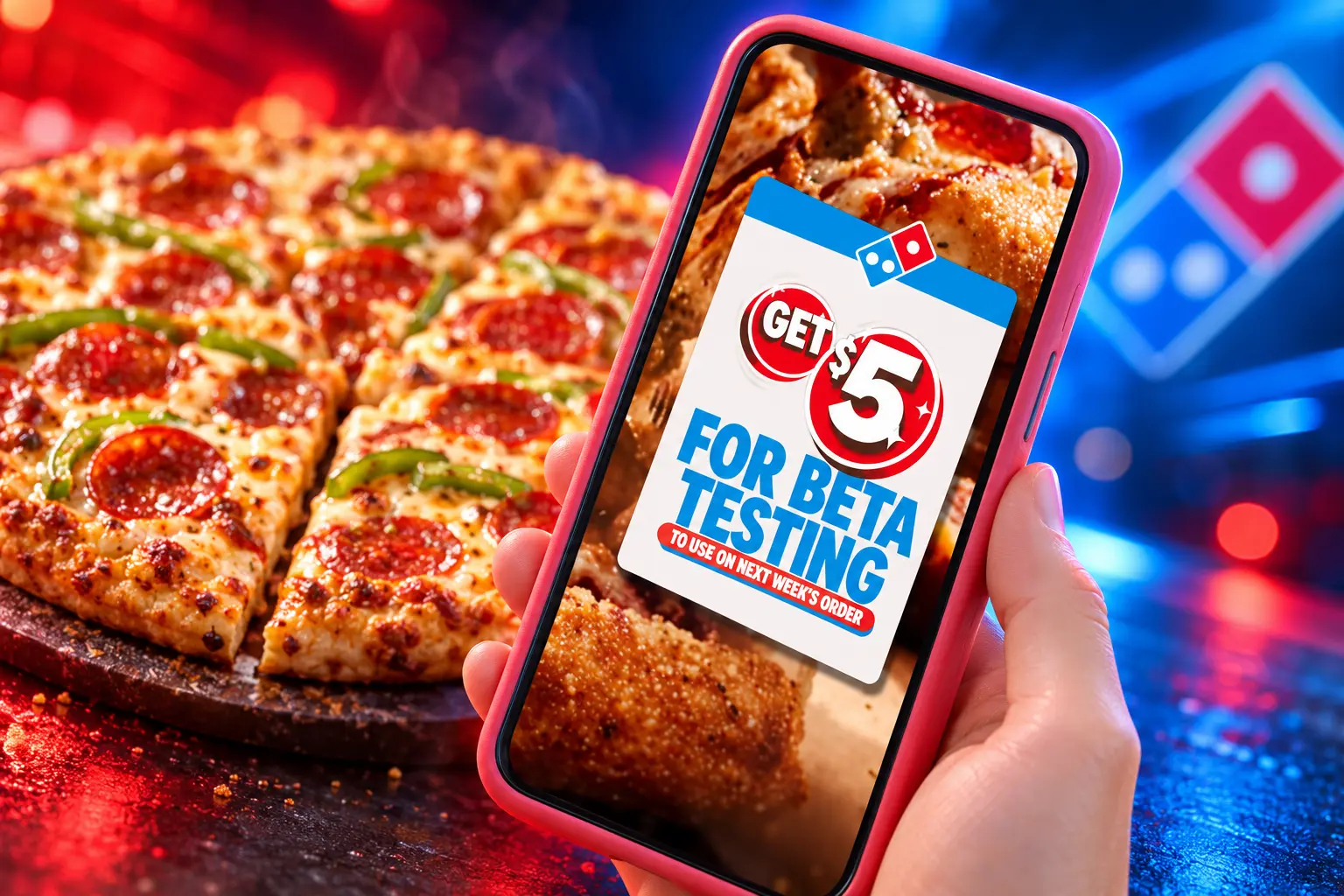
The Aug. 3 release from Ann Arbor did not sound like a patch note. Domino’s Pizza Inc. said it had redesigned the website and app earlier in the year “to make it even better, but don’t take our word for it.” Other companies, it said, treat consumers like guinea pigs and ask them to test for free. Domino’s would pay, with $5 off their next digital order.
Mark Messing, vice president of global digital marketing, cast the month as a listening tour. Feedback at the end of an order was optional. The coupon was not tied to a completed survey, which made the “beta” look a lot like a bounce-back deal with a research caption.
We streamlined our website and app to make them bolder, brighter, more modern, and engaging for customers, but we want to hear from them.
Mark Messing, vice president of global digital marketing, Aug. 3, 2026 press release
Weiner had already taken the company’s word for it. On the April 27, 2026 earnings call he said the new app was live, including a rebuilt Pizza Tracker, and that the modernized app was much easier and would allow more personalization later.
We fully launched our new app, including improvements to our world famous pizza tracker, which has tracked more than 2.5 billion orders since 2008. This new modernized app is much easier for our customers to use and will allow for more personalization over time.
Russell Weiner, chief executive, Q1 2026 earnings call
FROM FULL LAUNCH TO PAID BETA
- December 28, 2025: The annual report says the website and mobile web redesign are fully live, with mobile apps still rolling out.
- April 27, 2026: Weiner tells investors the new app is fully launched and easier to use.
- August 3, 2026: Domino’s starts a 28-day paid “beta” on the live site and app.
- August 28, 2026: The Play listing ships a note that a few bugs were resolved to improve ordering.
- August 30, 2026: The coupon window closes. Early September posts describe tester coupons that will not stick at checkout.
That calendar is the joke. A “beta” is supposed to sit in front of a national swap, not behind a CEO’s all-clear and a summer of one-star reviews.
The Pizza Tracker Brand Built a Catalog
Domino’s has sold itself for years as a software shop that happens to bake dough. The Tracker, live since 2008, has followed more than 2.5 billion orders. The 2025 annual report put digital’s share of U.S. retail sales above 85%. Founded in 1960, the chain now counts more than 22,500 stores in over 90 markets, and it posted more than $20.6 billion in global retail sales for the four quarters ended June 14, 2026.
The new screens do not look like that machine. Soren Iverson, founder of the consultancy Iverson, walked the onboarding, menu, and cart and said the pizza detail pages run “almost a full bleed image of a pizza,” closer to a shoppable magazine than to DoorDash, McDonald’s, or Starbucks, which pack reviews, past orders, and one-tap re-adds onto the same view. He called the feel “very editorial and almost like e-commerce.” The app also opens on a large looping pizza video.
Sophie Kuzmina, head of creative studio at InAppStory, put the hungry-user test in one line: when she opens a food app she is there to place an order, and she would rather get straight to the menu. As a signed-in user she saw a “welcome back” line and little else that treated a regular differently from a first-timer. Iverson said a returning customer’s primary action is placing an order, not watching something.
That is the product mistake under the brand refresh. A tracker company built a browse path. People who already know the pepperoni combo now wait through motion graphics that were meant to look bolder and brighter.
What Broke Between Reorder and Checkout
The lifetime scores still look healthy because they average years of the old compact app with months of the new one. The U.S. iPhone listing still shows 4.8 stars from 5 million ratings. Google Play lists 4.6 stars from 2.39 million reviews. The recent writing under those averages is about lost muscle memory, not about the box art.
FRICTIONS USERS KEEP HITTING
| Step | What changed |
|---|---|
| Reorder | More taps and scrolling; recent orders no longer carry the usual coupon in one path |
| Layout | Oversized type and full-bleed photos push the cart summary off the first screen |
| Saved details | Carside notes, delivery instructions, and tracking numbers fail to stick to an address |
| Account | Login drops, password loops, and lockouts after “too many” tries |
| Menu controls | Half-pizza no-cheese, a lactose workaround, disappeared after the swap |
App Store reviews from March through August repeat those rows. One longtime user said the font was so large that half the page was gone, saved info was wiped, and a parking-lot pickup became the backup. Another could no longer drop cheese on one half for a lactose-intolerant partner and had to call the store to fix every pie. A March review on the r/Dominos board called the new app nearly unusable and said the old path was recent order, tracker, then leave for pickup.
Some people like the glow. One April review called the update responsive, bright, and a serious upgrade. A June review said the new version ran smoother after rewards had failed on the old UI. The split is not mysterious. Shoppers who wanted a brand film got one. Shoppers who wanted last Tuesday’s order in three taps got a catalog.
85% of U.S. Sales Run Through That Screen
This would be a small complaint at a chain that still takes most tickets at a counter. Domino’s is not that chain. Digital is the storefront, and independent franchise owners ran 99% of stores at the end of the second quarter of 2026.
THE DIGITAL CASH REGISTER
- Digital mix: More than 85% of U.S. retail sales in 2025 ran through digital channels, per the company’s own August release.
- Tracker load: The Pizza Tracker has followed more than 2.5 billion orders since 2008.
- System size: More than 22,500 stores in over 90 markets, with more than $20.6 billion in global retail sales for the four quarters ended June 14, 2026.
- Ownership: Franchisees held 99% of stores as of the second quarter of 2026.
Brad Jashinsky, a director analyst at Gartner, argues the durable move is to keep investing in an app so it never feels stale, rather than to rip out a working order path in one drop. Iverson’s version of the same idea is uglier and more specific: add with care, because taking a feature out later has a technical cost and a loyalty cost. “It’s easier to add than it is to remove,” he said.
The lost-data row on that table is the expensive one. Reorder is how a pizza app prints money from people who already decided. When saved notes vanish and a coupon will not sit on a recent order, the next hungry minute belongs to whoever still has a one-tap button, including the aggregators Domino’s now also sells through.
Franchise Stores Posted a Zero Comp
Weiner did not blame the app on the July 20, 2026 call. He said second-quarter same-store sales missed because of ticket after a premium menu push, and that he was happy with order counts. The print still sat under a live, loudly disliked order path.
The second-quarter release listed U.S. same store sales growth of 0.1%, against 3.4% in the second quarter of 2025. U.S. retail sales rose 1.9%, against 5.1% a year earlier. Company-owned U.S. stores compiled a 2.1% gain. Franchise stores, almost the entire system, compiled 0.0%. Global retail sales, excluding currency, rose 3.0%, helped by 209 net new stores, 26 of them in the U.S. First-quarter U.S. same-store sales had been 0.9%, with carryout up 2.4% and delivery down 0.3%.
Those figures do not prove the redesign caused the slowdown. They do show who eats a slower order path. A corporate store can absorb a clunky cart for a quarter. A franchisee living on frequency cannot, and that owner did not design the looping video.
Even the Thank-You Coupons Would Not Stick
The paid month ended on Aug. 30. The checkout bugs did not. Two days before the window closed, Google Play carried a bug-fix update on Aug. 28 that thanked users and said a few bugs had been resolved to improve ordering. Early September still produced the same failure, now attached to the $5 the company had issued as proof it was listening.
WHAT FAILED AFTER THE COUPONS LANDED
- Vanishing $5: Testers described bounce-back coupons that disappeared from accounts before the next-week expiry.
- Stacked offers: Checkout dropped a tester coupon while a larger percent-off deal was in the cart, then dumped the order.
- Rewards wipe: At least one customer said rewards vanished in the same flow that was supposed to pay for the test.
- Pretty vs. fast: Returning users still met rotating pizza loops and giant topping photos before they could repeat last week’s pie.
The louder product problem is not that a pizza photo is too sharp. It is that the thank-you for surviving the new UI had to travel through the same UI. Paying people to test a live app is already backwards. Paying them in a coupon the live app then drops is the extra turn.
Hungry regulars do not need a side gig. They need last week’s order, the note about the side door, and a deal that still sits in the cart when they hit pay. The new screens keep asking them to watch the food first.
Feature Flags Stayed Off for a National Swap
Iverson’s advice for a large redesign is the unglamorous kind: a phased rollout with feature flags and do-no-harm scores, 1% of users at a time, measured, not a national bandage pull. He also said brands should warn 30 to 60 days before they sunset a function people rely on. Kuzmina’s rule is even simpler. Keep ordering clear and fast, and put news in a separate message when there is something useful to say.
It’s a tricky thing but an important thing to make sure that the customer is being listened to and heard and advocated for.
Soren Iverson, founder, Iverson
Domino’s did listen, in a way. It listened after the CEO had already declared the app easier, after franchise comps in the first full quarter of the native app printed a zero, and after the store listings filled with notes about huge type and missing cheese controls. Then it paid for a beta that did not require a survey and still could not keep its own $5 attached to a cart.
The lifetime 4.8 on iPhone will hide that sequence for a while, because millions of old five-star taps still sit in the average. The people who order every week already voted with extra taps, extra calls to the store, and coupons that fell off the screen that was supposed to collect them.

Anker’s $94 MagSafe Dock Undercuts Apple on Prime Day

LG Will Sell the Apple-Designed Lock and Thermostat

Claude Asks to Keep Voice Recordings It Once Deleted

Jeep Bets One Grand Wagoneer Can Replace Two

Kortext Buys the Study Tool Already Inside Campus Software
How to Remove Sewn-In Tags – Techniques for Tag Removal from Clothing

Long Realty Drops Lundeen After the Flight 618 Arrest

Land Rover Pushes the Electric Defender Into the 2030s

Boox Picco Drops Phone Magnets for a Pocket Linux Reader

OPEC+ Holds October Oil Output After Six Paper Hikes
-
LIFESTYLE3 years ago
How to Remove Sewn-In Tags – Techniques for Tag Removal from Clothing
-
 BUSINESS1 month ago
Long Realty Drops Lundeen After the Flight 618 Arrest
-
 AUTO2 months ago
Land Rover Pushes the Electric Defender Into the 2030s
-
 NEWS1 month ago
Boox Picco Drops Phone Magnets for a Pocket Linux Reader
-
 BUSINESS1 month ago
OPEC+ Holds October Oil Output After Six Paper Hikes
-
 GAMING1 month ago
Kalshi Asks 11 Judges to Undo a Sports-Swap Split
-
 LIFESTYLE3 years ago
American Eagle Style Number on Tag – Decoding Clothing Label Information
-
 NEWS1 month ago
swXtch.io Lets a Chat Deploy Live Media Stacks