
NEWS
Nvidia’s 2 GW Australia Bet Runs Through the Grid
NVIDIA lined up eight Australian partners for up to 2 GW of DSX AI factories by 2027, a target the grid’s 67 GW connection queue already dwarfs.

NVIDIA named eight Australian partners on September 9, 2026, for up to a 2-gigawatt buildout by 2027. That figure is 125% of the 1.6 gigawatts Data Centres Australia, citing DC Byte, counts as national computing capacity.
The company said the sites will be built around its DSX AI-factory stack. It did not publish GPU volumes for the program, partner purchase commitments, or a dollar value. NVIDIA shares changed hands near $218 in New York on September 10, about 2.5% below a September 9 close near $223.67.
NEWS: NVIDIA and Australia’s AI infrastructure ecosystem are expanding land, power and shell capacity to host AI factories, supporting the nation’s growing demand for AI compute.
Built on NVIDIA DSX, these full-stack AI factories provide high-performance AI compute for…
— NVIDIA Newsroom (@nvidianewsroom) September 10, 2026
Eight Australian Partners and a 2 GW Target
The Melbourne announcement is a collaboration, not a disclosed offtake deal. NVIDIA said it will supply the DSX platform, accelerated computing, networking, software, and partner support. The eight firms will operate the plants. The capacity NVIDIA is expanding is land, power, and shell space designed to host more than one generation of DSX gear.
Raj Mirpuri, vice president of global AI clouds and infrastructure ecosystem at NVIDIA, put the commercial claim in one line.
AI factories turn energy into intelligence
Raj Mirpuri, vice president of global AI clouds and infrastructure ecosystem, NVIDIA, September 9, 2026 newsroom statement
He also called DSX a full-stack platform that stays compatible with CUDA and can be improved in software over the life of the plant, which is how NVIDIA wants landlords to treat the stack as an investable asset rather than a one-cycle chip buy.
THE EIGHT FIRMS NAMED
- Firmus: Expanding Project Southgate for hyperscale and AI-native demand in Australia and Asia-Pacific.
- Sharon AI: Deploying up to 68,000 NVIDIA GPUs on Quantum InfiniBand and Spectrum-X Ethernet, the only chip count in the release.
- IREN: Pairing DSX with its own power, land, and operations, including the 800-megawatt Bundey campus in South Australia.
- Megaport: Expanding NVIDIA compute access through its Latitude.sh unit and its software-defined network.
- ResetData: Building onshore AI cloud capacity for enterprises, government, and research that need Australian data residency.
- CDC: More than 550 megawatts in service across Australia and New Zealand, with a further 800 megawatts under construction.
- NEXTDC: Liquid-cooled halls it says can host DSX factories and connect to major public clouds.
- AirTrunk: Adding AI-ready powered shells and direct-to-chip liquid cooling across the region.
NVIDIA’s own text says those firms are already investing in DSX plants. The 2 GW figure is a wrapper around work that was under way, plus a public deadline of 2027, not a new order log the company can book this quarter.
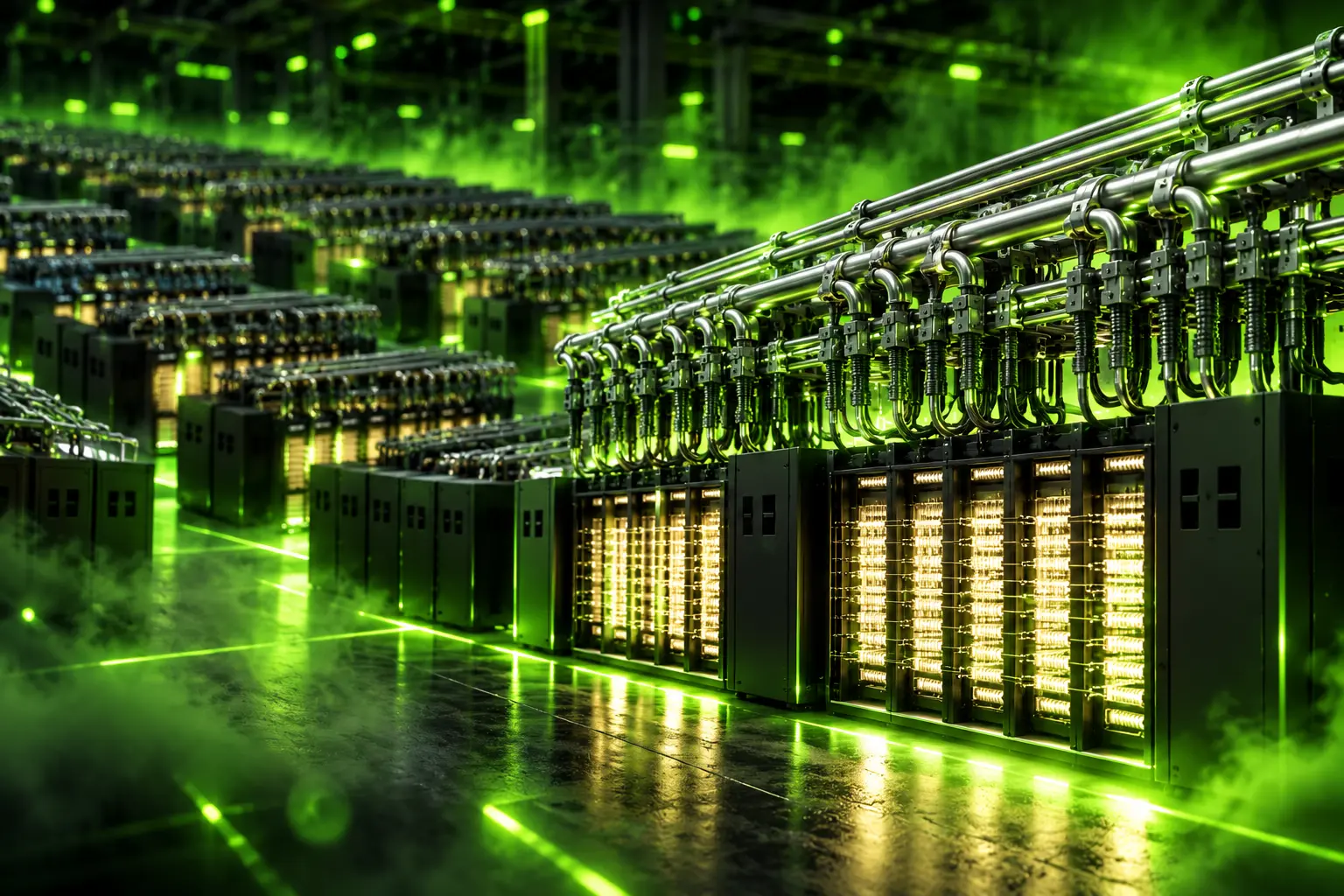
NVIDIA DSX Reaches From the Chip to the Grid
DSX is the product being planted in Australia, and it is wider than a GPU. NVIDIA’s product page says the platform defines how AI factories are designed and run from the grid, facilities, and chips through software and partner gear, with the aim of more useful output from the power that is actually available.
The kit list is the tell. DSX Reference Design covers validated layouts from silicon to the substation. DSX Sim is meant to catch bottlenecks before steel goes in. DSX OS is the operations layer. DSX Exchange moves signals among compute, cooling, and power plant systems. DSX MaxLPS is power software NVIDIA says can recover stranded watts so a site can run up to 40% more GPUs inside a fixed megawatt budget.
DSX Flex is the piece that maps onto Australia’s grid problem. NVIDIA says it takes utility signals, including load shedding, demand response, and price events, and shifts workloads, on-site renewables, and storage in response. That is a product for a country where the scarce input is no longer a shipment of accelerators. It is a connection agreement, a firming contract, and a load that can throttle when the system asks.
Jensen Huang, NVIDIA’s founder and chief executive, has sold that playbook in those terms: operators can simulate the factory before they spend, then check performance before a rack is installed. For the eight Australian names, the pitch is a repeatable hall, not a one-off cluster.
The Queue Already Holds 67 GW of Data Center Requests
The Australian Energy Market Operator published its 2026 Electricity Statement of Opportunities on August 25, 2026, two weeks before NVIDIA’s event. Network businesses had already told AEMO that proposed data-center connection capacity across the National Electricity Market had risen from 38 GW to 67 GW. That is the queue. It is not a build forecast.
AEMO counted 225 known data-center projects in various stages of connection. It also said more than 40% of data-center projects since 2025 had dropped out or moved backward in connection status. Mature plants, in AEMO’s cut, use about 50% of the capacity they reserved on the network. New halls often take five to 10 years to reach full demand.
On energy, not nameplate, the operator’s central path has data-center consumption rising from about 5 TWh to 34 TWh between 2025-26 and 2035-36. That is a move from about 3% of grid supply to about 13%. Daniel Westerman, AEMO’s chief executive, said the reliability outlook has improved, with no forecast reliability gaps before 2030, after 9.1 GW of new generation and storage reached full output in 2025-26. About 15 GW of coal and gas plant is still due to retire over the next decade, and total consumption is forecast to rise by more than 40%.
HOW 2 GW SITS AGAINST THE GRID FILE
| Measure | Figure | Whose number |
|---|---|---|
| Australian computing capacity now | 1.6 GW | Data Centres Australia, citing DC Byte |
| NVIDIA AI-factory target by 2027 | up to 2 GW | NVIDIA, September 9, 2026 |
| NEM data-center connection requests | 67 GW | AEMO 2026 ESOO |
| Data-center share of NEM supply, 2025-26 | about 3% | AEMO |
| Data-center share of NEM supply, 2035-36 | about 13% | AEMO |
Commonwealth Bank of Australia, in an August 2026 note, put about six gigawatts of potential capacity in the national pipeline, roughly four times what it recorded as operational at the end of 2025, and estimated the build could run to about 150 billion Australian dollars by 2030. That pipeline number and AEMO’s 67 GW of connection requests are different ledgers. One is an investment screen. The other is what networks have been asked to study. Neither is NVIDIA revenue.
Australia’s 2027 Date Runs Through the Substation
A 2027 deadline on a 2 GW AI-factory target is a construction and interconnection date. NVIDIA did not publish a megawatt-by-megawatt switch-on schedule. AEMO’s own file says large new halls ramp for years after they connect, and a large share of proposed projects never hold their place in the queue.
The bottleneck argument circulating around the announcement is the blunt one: the constraint has moved from silicon to electrons. Eight partners can order racks faster than an eastern-state network can study, approve, and energise the load behind them. DSX Flex is NVIDIA’s answer to that, on paper. It does not shorten a connection queue by itself.
THE DATES BEHIND THE 2 GW CLAIM
- May 31, 2026: NVIDIA announces the DSX platform as a playbook for AI-factory design, simulation, and operations.
- July 26, 2026: NVIDIA’s second quarter of fiscal 2027 ends, with Data Center still the bulk of sales.
- August 25, 2026: AEMO publishes the 2026 ESOO, including the 67 GW data-center connection tally and the 5 TWh to 34 TWh demand path.
- August 26, 2026: NVIDIA reports the quarter and guides to $108.0 billion of revenue, plus or minus 2%, for the current period, with no China data-center compute in the outlook.
- September 9, 2026: NVIDIA names the eight Australian partners and the 2 GW target.
- 2027: Stated deadline for the Australian buildout.
From the September 9 announcement to the end of 2027 is a short window for greenfield power. Several of the named sites are not greenfield. That is the only way the date is even in range.
Bundey, Southgate and the Operators Who Must Deliver
IREN is the partner that talks like a power company. Daniel Roberts, cofounder and co-CEO, said a repeatable DSX blueprint is being applied across its development portfolio, including the 800-megawatt Bundey campus in South Australia. If Bundey is built to that published size, it is a large fraction of NVIDIA’s national target on a single site, and it is a site IREN was already developing.
CDC is the largest operator in the group by plant already running. Greg Boorer, founder and CEO, said the company has more than 550 megawatts in service across Australia and New Zealand and a further 800 megawatts under construction, on 100% renewable electricity, with zero-water cooling certified for NVIDIA gear. Those megawatts are not all incremental AI factories, and they include New Zealand. They do show why NVIDIA went looking for landlords who already hold land and power, not for a blank-map 2 GW campus.
Firmus is scaling Project Southgate. Oliver Curtis, cofounder and co-CEO, called it a concrete step for Australian businesses and researchers who want the compute onshore. Sharon AI, through CEO James Manning, is the partner that put a GPU number on the table: up to 68,000 accelerators, framed as sovereign capacity that does not have to leave the country for a US cloud. ResetData is selling the same residency pitch to government and labs. Megaport is the network overlay. AirTrunk and NEXTDC are the shell and cooling specialists for dense racks.
Heidi, a clinical AI firm, and Atlassian are the two application names NVIDIA used to show that the stack has local software demand, including Nemotron open models. They are customers of the compute story, not builders of the 2 GW. The people who have to pour slabs, pull permits, and hold connection offers are the eight on the partner list.
Nvidia’s $96.2 Billion Quarter Still Has No Australia Bookings
NVIDIA’s last reported quarter is the scale against which 2 GW of unpaid Australian shells has to be judged. For the period ended July 26, 2026, the company posted second-quarter revenue of $96.2 billion, up 18% from the prior quarter and 106% from a year earlier. Data Center revenue was $89.0 billion, up 18% sequentially and 117% year on year, or about 92.5% of the company. GAAP and non-GAAP gross margins were both 75.0%.
Q2 FY27 IN FOUR LINES
- Total revenue: $96.2 billion, up 106% from a year earlier.
- Data Center: $89.0 billion, about 92.5% of sales.
- Gross margin: 75.0% on both GAAP and non-GAAP.
- Current-quarter guide: $108.0 billion, plus or minus 2%, with no China data-center compute assumed.
Huang’s line on that call was that tokens are now productive and that compute is revenue. An Australian land-power-shell program does not show up in those figures until someone buys the racks and turns them on. The September 10 share price, near $218 and about 2.5% lower on the day, is consistent with a market that already needed the $108.0 billion guide more than it needed another national target with no volumes attached.
What the 2 GW Target Leaves Unsaid
Read the release for what is missing and the 2027 date gets clearer. NVIDIA did not assign a dollar value to the Australian program. It did not say how many of the 2 GW are new connections versus halls already in CDC, NEXTDC, AirTrunk, IREN, or Firmus pipelines. It named one GPU figure, Sharon AI’s up to 68,000, and left the other seven partners without a chip count. It did not say which networks have accepted the loads, or on what energisation dates.
WHAT WE KNOW
- The public target: Up to 2 GW of DSX-ready capacity in Australia by 2027, across eight named operators.
- The product: Land, power, and shell designed for DSX, plus NVIDIA compute, networking, and software.
- The grid file: 67 GW of data-center connection requests, more than 40% attrition since 2025, and a 5 TWh to 34 TWh demand path to 2035-36.
WHAT IS UNCONFIRMED
- Booked sales: No disclosed GPU volumes for the 2 GW, no partner purchase commitments, no program capital figure.
- Switch-on dates: No site-level interconnection calendar that would put 2 GW on the bus by the end of 2027.
- Additive load: No split between new megawatts and projects that were already in construction or in the queue.
If the eight builders fill those shells, NVIDIA gets another national DSX estate and CUDA stays the default on Australian AI plants for more than one chip cycle. If the queue keeps eating projects, 2027 becomes a marketing year on a slower physical build. The next hard numbers to watch are not another gigawatt target. They are connection offers, energised megawatts, and the first GPU shipments that can be tied to this list by name.
Disclaimer: This article is news reporting and analysis of a corporate capacity target and related energy-market figures. It is for information only and is not investment advice, a recommendation to buy or sell NVIDIA or any Australian operator, or a forecast of earnings. Readers should consult a licensed financial adviser or broker before acting on any share, bond, or project-finance decision. Figures and statuses reflect the company statements, AEMO publications, and market data cited here as of their stated dates and can change as connection queues, partner plans, and quarterly results are updated.

Anker’s $94 MagSafe Dock Undercuts Apple on Prime Day

LG Will Sell the Apple-Designed Lock and Thermostat

Claude Asks to Keep Voice Recordings It Once Deleted

Jeep Bets One Grand Wagoneer Can Replace Two

Kortext Buys the Study Tool Already Inside Campus Software
How to Remove Sewn-In Tags – Techniques for Tag Removal from Clothing

Long Realty Drops Lundeen After the Flight 618 Arrest

Land Rover Pushes the Electric Defender Into the 2030s

Boox Picco Drops Phone Magnets for a Pocket Linux Reader

OPEC+ Holds October Oil Output After Six Paper Hikes
-
LIFESTYLE3 years ago
How to Remove Sewn-In Tags – Techniques for Tag Removal from Clothing
-
 BUSINESS2 months ago
Long Realty Drops Lundeen After the Flight 618 Arrest
-
 AUTO2 months ago
Land Rover Pushes the Electric Defender Into the 2030s
-
 NEWS2 months ago
Boox Picco Drops Phone Magnets for a Pocket Linux Reader
-
 BUSINESS2 months ago
OPEC+ Holds October Oil Output After Six Paper Hikes
-
 GAMING1 month ago
Kalshi Asks 11 Judges to Undo a Sports-Swap Split
-

 LIFESTYLE3 years ago
American Eagle Style Number on Tag – Decoding Clothing Label Information
-

 NEWS1 month ago
ChatGPT Images 2.5 Splits Image Work Into Two Speeds